10-K: Annual report [Section 13 and 15(d), not S-K Item 405]
Published on February 26, 2026
UNITED STATES
SECURITIES AND EXCHANGE COMMISSION
Washington, D.C. 20549
FORM
For the fiscal year ended
Commission File Number
BARRETT BUSINESS SERVICES, INC.
(Exact name of registrant as specified in its charter)
|
||
(State or other jurisdiction of |
|
(IRS Employer |
incorporation or organization) |
|
Identification No.) |
|
|
|
|
|
|
|
||
(Address of principal executive offices) |
|
(Zip Code) |
(
(Registrant's telephone number, including area code)
Securities registered pursuant to Section 12(b) of the Act:
Title of each class |
Trading Symbol(s) |
Name of each exchange on which registered |
Securities registered pursuant to Section 12(g) of the Act: None
Indicate by check mark if the registrant is a well-known seasoned issuer, as defined in Rule 405 of the Securities Act. ☒ No ☐
Indicate by check mark if the registrant is not required to file reports pursuant to Section 13 or Section 15(d) of the Act. Yes ☐
Indicate by check mark whether the registrant: (1) has filed all reports required to be filed by Section 13 or 15(d) of the Securities Exchange Act of 1934 during the preceding 12 months (or for such shorter period that the registrant was required to file such reports), and (2) has been subject to such filing requirements for the past 90 days.
Indicate by check mark whether the registrant has submitted electronically every Interactive Data File required to be submitted pursuant to Rule 405 of Regulation S-T (§ 232.405 of this chapter) during the preceding 12 months (or for such shorter period that the registrant was required to submit such files).
Indicate by check mark whether the registrant is a large accelerated filer, an accelerated filer, a non-accelerated filer, smaller reporting company, or an emerging growth company. See the definitions of “large accelerated filer,” “accelerated filer,” “smaller reporting company,” and “emerging growth company” in Rule 12b-2 of the Exchange Act.
Accelerated filer ☐ |
Non-accelerated filer ☐ |
Smaller reporting company |
|
Emerging growth company |
|
|
|
If an emerging growth company, indicate by check mark if the registrant has elected not to use the extended transition period for complying with any new or revised financial accounting standards provided pursuant to Section 13(a) of the Exchange Act. ☐
Indicate by check mark whether the registrant has filed a report on and attestation to its management’s assessment of the effectiveness of its internal control over financial reporting under Section 404(b) of the Sarbanes-Oxley Act (15 U.S.C. 7262(b)) by the registered public accounting firm that prepared or issued its audit report.
If securities are registered pursuant to Section 12(b) of the Act, indicate by check mark whether the financial statements of the registrant included in the filing reflect the correction of an error to previously issued financial statements.
Indicate by check mark whether any of those error corrections are restatements that required a recovery analysis of incentive-based compensation received by any of the registrant’s executive officers during the relevant recovery period pursuant to §240.10D-1(b). ☐
Indicate by check mark whether the registrant is a shell company (as defined in Rule 12b-2 of the Act). Yes
State the aggregate market value of the common equity held by non-affiliates of the registrant: $
Indicate the number of shares outstanding of each of the registrant's classes of common stock, as of the latest practicable date:
Class |
Outstanding at February 11, 2026 |
Common Stock, Par Value $.01 Per Share |
DOCUMENTS INCORPORATED BY REFERENCE
Portions of the definitive Proxy Statement for the 2026 Annual Meeting of Stockholders are hereby incorporated by reference in Part III of Form 10-K.
BARRETT BUSINESS SERVICES, INC.
2025 ANNUAL REPORT ON FORM 10-K
TABLE OF CONTENTS
|
|
|
Page |
|
Item 1. |
|
|
2 |
|
|
|
|
|
|
Item 1A. |
|
|
9 |
|
|
|
|
|
|
Item 1B. |
|
|
22 |
|
|
|
|
|
|
Item 1C. |
|
|
23 |
|
|
|
|
|
|
Item 2. |
|
|
24 |
|
|
|
|
|
|
Item 3. |
|
|
25 |
|
|
|
|
|
|
Item 4. |
|
|
25 |
|
|
|
|
|
|
|
|
|
|
|
Item 5. |
|
|
25 |
|
|
|
|
|
|
Item 7. |
|
Management’s Discussion and Analysis of Financial Condition and Results of Operations |
|
27 |
|
|
|
|
|
Item 7A. |
|
|
34 |
|
|
|
|
|
|
Item 8. |
|
|
35 |
|
|
|
|
|
|
Item 9. |
|
Changes in and Disagreements With Accountants on Accounting and Financial Disclosure |
|
64 |
|
|
|
|
|
Item 9A. |
|
|
64 |
|
|
|
|
|
|
Item 9B. |
|
|
67 |
|
|
|
|
|
|
Item 9C. |
|
Disclosure Regarding Foreign Jurisdictions that Prevent Inspections |
|
67 |
|
|
|
|
|
|
|
|
|
|
Item 10. |
|
|
68 |
|
|
|
|
|
|
Item 11. |
|
|
68 |
|
|
|
|
|
|
Item 12. |
|
Security Ownership of Certain Beneficial Owners and Management and Related Stockholder Matters |
|
68 |
|
|
|
|
|
Item 13. |
|
Certain Relationships and Related Transactions, and Director Independence |
|
68 |
|
|
|
|
|
Item 14. |
|
|
68 |
|
|
|
|
|
|
|
|
|
|
|
Item 15. |
|
|
69 |
|
|
|
|
|
|
Item 16. |
|
|
72 |
|
|
|
|
||
|
73 |
|||
|
|
|
|
|
|
|
|
||
1
PART I
Item 1. BUSINESS
General
Company Background
Barrett Business Services, Inc. (“BBSI,” the “Company,” “our” or “we”), is a leading provider of business management solutions for small and mid-sized companies. The Company has developed a management platform that integrates a knowledge-based approach from the management consulting industry with tools from the human resource outsourcing industry. This platform, through the effective leveraging of human capital, helps our business owner clients run their businesses more effectively. We believe this platform, delivered through a decentralized organizational structure, differentiates BBSI from our competitors. BBSI was incorporated in Maryland in 1965.
Certain statements below contain forward-looking information that is subject to risks and uncertainties. See “Forward-Looking Information” in Item 7 of Part II of this report and “Risk Factors” in Item 1A of Part I of this report.
Business Strategy
Our strategy is to align local operations teams with the mission of small and mid-sized business owners, driving value to their business. To do so, BBSI:
Business Organization
We operate a decentralized delivery model using operationally-focused business teams, typically located within 50 miles of our client companies. These teams are led by experienced business generalists and include senior level professionals with expertise in human resources, organizational development, risk mitigation and workplace safety, recruiting, employee benefits, and various types of administration, including payroll. These teams are responsible for growth and profitability of their operations, and for providing strategic leadership, guidance and expert consultation to our client companies. The decentralized structure fosters autonomous decision-making in which business teams deliver plans that closely align with the objectives of each business owner client.
Services Overview
BBSI’s core purpose is to advocate for business owners, particularly in the small and mid-sized business segment. Our evolution from an entrepreneurially run company to a professionally managed organization has helped to form our view that all businesses experience inflection points at key stages of growth. The insights gained through our own growth, along with the trends we see in working with more than 8,200 companies each day, define our approach to guiding business owners through the challenges associated with being an employer. BBSI’s business teams align with each business owner client through a structured three-tiered progression. In doing so, business teams focus on the objectives of each business owner and deliver planning, guidance and resources in support of those objectives.
Tier 1: Tactical Alignment
The first stage focuses on the mutual setting of expectations and is essential to a successful client relationship. It begins with a process of assessment and discovery in which the business owner’s
2
business objectives, philosophies and culture are aligned with BBSI’s processes, controls and culture. This stage includes an implementation process, which addresses the administrative components of employment.
Tier 2: Dynamic Relationship
The second stage of the relationship emphasizes organizational development as a means of achieving each client’s business objectives. There is a focus on process improvement, development of best practices, supervisor training and leadership development.
Tier 3: Strategic Counsel
With an emphasis on advocacy on behalf of the business owner, the third stage of the relationship is more strategic and forward-looking with a goal of cultivating an environment in which all efforts are directed by the mission and long-term objectives of the business owner.
In addition to serving as a resource and guide, BBSI can provide workers’ compensation coverage as a means of meeting statutory requirements and protecting our clients from employment-related injury claims. Through our third-party administrators, we provide claims management services for our clients. We work to manage and reduce job injury claims, identify fraudulent claims and structure optimal work programs, including modified duty.
BBSI also offers employee benefit programs to our clients. The benefit programs available to our clients include medical, dental and vision plans, flexible spending accounts and health savings accounts, life insurance and voluntary accident coverage, and critical illness and disability coverage, among others. These employee benefit programs are offered through fully insured arrangements with third-party carriers and are designed to provide strategic value to our clients through access to best-in-class plans and service.
Categories of Services
We report financial results in two categories of services: Professional Employer Services (“PEO”) and Staffing. See Item 7 of Part II of this Report for information regarding the percentages of total net revenues provided by our PEO and staffing services for each of the last three fiscal years, and our consolidated financial statements in Item 8 of Part II of this Report for information regarding revenues, net income and total assets in our single reportable segment.
PEO
We enter into a client services agreement to establish a co-employment relationship with each client company, assuming responsibility for payroll, payroll taxes, workers’ compensation (if elected) and benefits coverage (if elected) and certain other administrative functions for the client’s existing workforce. We provide our PEO clients with access to human resource advisors and a human resources information system (HRIS), retirement plans, a learning management system and our web-based technology platform, myBBSI.
We refer to employees of our PEO clients as worksite employees (“WSEs”). The client maintains physical care, custody and control of the WSEs, including the authority to hire and terminate employees. During 2025, we supported in excess of 8,200 PEO clients with total average WSEs of 138,218.
Staffing and Recruiting
Our staffing services include on-demand or short-term staffing assignments, contract staffing, direct placement (including for PEO and non-PEO clients), and long-term or indefinite-term on-site management. On-site management employees are BBSI management employees who are based on the client-site and whose jobs are to assist BBSI staffing employees. Our recruiting experts maintain a deep network of professionals from which we source candidates. Through an assessment process, we gain an understanding of the short and long-term needs of our clients, allowing us to identify and source the right talent for each position. We then conduct a rigorous screening process to help ensure a successful hire.
3
Clients and Client Contracts
Our PEO business is typically characterized by long-term relationships that result in recurring revenue. The terms and conditions applicable to our client relationships are set forth in a client services agreement, which typically provides for an initial term of one year with renewal for additional one-year periods, but generally permits cancellation by either party upon 30 days’ written notice. In addition, in most cases we may terminate the agreement at any time for certain breaches of contract, including nonpayment or failure to follow our workplace safety recommendations.
The PEO client services agreement also provides for indemnification by the client against losses arising out of any default by the client under the agreement, including failure to comply with any employment-related, health and safety, or immigration laws or regulations. Our client service agreement requires that clients enter a co-employment arrangement and maintain comprehensive liability coverage in the amount of $1.0 million for acts of their employees. It is nevertheless possible that claims not satisfied or covered through indemnification or insurance may be asserted against us, which could adversely affect our results of operations.
We have PEO client services agreements with customers in a diverse array of industries, including, among others, construction, waste management and remediation services, manufacturing, transportation and warehousing, health care, leisure and hospitality, retail, professional and advisory services and wholesale trade. None of our clients individually represented more than 1% of our total revenues in 2025.
Market Opportunity
As a PEO that aligns with the mission of business owners by providing resources and guidance to small and mid-size businesses, BBSI believes its growth is driven by the desire of business owners to focus on mission-critical functions, reduce complexity associated with the employment function, mitigate costs and maximize their investment in human capital. Our integrated management platform has enabled us to capitalize on these needs within the small to mid-size business sector.
The small and mid‑sized business sector is particularly attractive because:
Competition
The business environment in which we operate is characterized by intense competition and fragmentation. BBSI is not aware of reliable statistics regarding the number of its competitors, but certain large, well-known companies typically compete with us in the same markets and have greater financial and marketing resources than we do, including Automatic Data Processing, Inc., ManpowerGroup, Inc., Kelly Services, Inc., Insperity, Inc., TriNet Group, Inc., Robert Half International Inc. and Paychex, Inc. We face additional competition from regional providers and we may in the future also face competition from new entrants to the field, including other staffing services companies, payroll processing companies and insurance companies. The principal competitive factors in the business environment in which we operate are price and level of service.
We believe that our growth is attributable to our ability to provide small and mid-sized companies with the resources and knowledge base of a large employer delivered through a local operations team. Our level of integration with each client business provides us an additional competitive advantage.
4
Technology Platform
Our client-facing technology platform, myBBSI, includes both internally developed and licensed software which gives our clients a wide range of tools, including the ability to process payroll, collect and process time and attendance information, manage human resource information including employee onboarding and termination, as well as compensation, benefits, and payroll tax reporting.
Growth Strategy
We believe our clients are our best advocates and powerful drivers of referral-based growth. In each market, operations teams provide expertise, consultation and support to our clients, driving growth and supporting retention. We anticipate that by adding business teams to existing branches, we can achieve incremental growth in those markets, driven by our reputation and by client referrals. In most markets, business development efforts are led by area managers and are further supported by business development managers.
Our business growth has three primary sources: referrals from existing clients, direct business-to-business sales efforts by our area managers and business development managers, and an extensive referral network. Partners in our referral network include insurance brokers, financial advisors, attorneys, CPAs, and other business professionals who can facilitate an introduction to prospective clients. These referral partners facilitate introductions to business owners on our behalf, typically in exchange for a fee equal to a small percentage of payroll.
We see two key drivers to our growth:
Workers’ Compensation
Through our client services agreement, BBSI can provide workers’ compensation coverage to its clients. We provide this coverage through a variety of methods, all of which are subject to rigorous underwriting to assess financial stability, risk factors and cultural alignment related to safety and the client’s desire to improve their operations. In providing this coverage, we are responsible for complying with applicable statutory requirements for workers' compensation coverage.
Risk mitigation is also an important contributor to our principal goal of helping business owners operate their business more efficiently. It is in the mutual interests of the client and BBSI to commit to workplace safety and risk mitigation. We maintain clear guidelines for our area managers and risk management consultants, directly tying their incentive compensation to their diligence in understanding and addressing the risks of accident or injury associated with the industries in which client companies operate and in monitoring clients’ compliance with workplace safety requirements.
Elements of Workers' Compensation System
State law (and for certain types of employees, federal law) generally mandates that an employer reimburse its employees for the costs of medical care and other specified benefits for injuries or illnesses, including catastrophic injuries and fatalities, incurred in the course and scope of employment. Most states
5
require employers to maintain workers' compensation insurance or otherwise demonstrate financial responsibility to meet workers' compensation obligations to employees. The benefits payable for various categories of claims are determined by state regulation and vary with the severity and nature of the injury or illness and other specified factors. In return for this guaranteed protection, workers' compensation is an exclusive remedy and employees are generally precluded from seeking other damages from their employer for workplace injuries. In many states, employers who meet certain financial and other requirements are permitted to self-insure.
Insured Program
The Company provides workers’ compensation coverage for client employees primarily through arrangements with fully licensed, third-party insurers (the “insured program”). Under this program, carriers issue policies or afford coverage to the Company’s clients under a program maintained by the Company. Approximately 86% of the Company’s workers’ compensation exposure is covered through the insured program.
The Company maintains a fully insured arrangement for its insured program, whereby third-party insurers assume substantially all risk of loss for claims incurred under the program. This fully insured arrangement covers claims incurred between July 1, 2021 and June 30, 2026.
The Company's fully insured policies allow for return premiums if claims develop favorably, ranging from $20.0 million to $30.0 million, depending on the policy period. For the policy period beginning July 1, 2021, BBSI can incur additional premiums up to $7.5 million if claims develop adversely. For all other policy years, no additional premiums can be charged based on claim performance.
Premiums incurred but not paid are recorded as either current or long-term premium payable on the consolidated balance sheets based on the expected timing of the payments.
For claims incurred under the insured program prior to July 1, 2021, the Company retains risk of loss up to the first $3.0 million per occurrence on policies issued after June 30, 2020 and $5.0 million per occurrence on policies issued before that date.
Claim obligations for policies issued under the insured program between February 1, 2014 and June 30, 2018 were removed through loss portfolio transfers in 2020 and 2021.
Self-Insured Programs
The Company is a self-insured employer with respect to workers' compensation coverage for all employees, including employees of PEO clients that elect to participate in our workers’ compensation program, working in Colorado, Maryland, Ohio, and Oregon. In the state of Washington, state law allows only the Company's staffing services and internal management employees to be covered under the Company's self-insured workers' compensation program. The Company also operates a wholly owned, fully licensed insurance company, Ecole, which provides workers’ compensation coverage to client employees working in Arizona and Utah. Approximately 14% of the Company’s workers’ compensation exposure is covered through self-insurance or Ecole (the “self-insured programs”).
For all claims incurred under the Company’s self-insured programs, the Company retains risk of loss up to the first $3.0 million per occurrence, except in Maryland and Colorado, where the Company’s retention per occurrence is $1.0 million and $2.0 million, respectively. For claims incurred under the Company’s self-insured programs prior to July 1, 2020, the Company retains risk of loss up to the first $5.0 million per occurrence, except in Maryland and Colorado, where the retention per occurrence is $1.0 million and $2.0 million, respectively.
Claims Management
As a result of our status as a self-insured employer in four states, our remaining retention arrangements, and the premium adjustments allowable under our fully insured policies, our workers' compensation expense is tied directly to the incidence and severity of covered workplace injuries. We seek to contain our workers' compensation costs through a comprehensive approach to claims management. We use managed-care systems to reduce medical costs and keep time-loss costs to a minimum by assigning injured workers, whenever possible, to short-term assignments which accommodate the workers' physical limitations. We believe that these assignments minimize both time actually lost from work and covered
6
time-loss costs. We engage a third-party claims administrator ("TPA") to provide the primary claims management expertise. Typical claims management procedures include performing thorough and prompt on-site investigations of claims filed by employees, working with physicians to encourage efficient medical management of cases, denying questionable claims and attempting to negotiate early settlements to eliminate future adverse development of claims costs. We also maintain a corporate-wide pre-employment drug screening program and a post-injury drug test program. We believe our claims management program has resulted in a reduction in the frequency of fraudulent claims and in accidents in which the use of illicit drugs appears to have been a contributing factor.
Sponsored Benefits
BBSI offers employee benefits to its PEO client employees. As a plan sponsor, BBSI engages with third-party insurance carriers to enter into fully insured arrangements to offer a wide range of employee benefit programs to our clients, including medical, dental and vision plans, flexible spending accounts and health savings accounts, life insurance and voluntary accident coverage, and critical illness and disability coverage, among others.
As the sponsor and administrator of the PEO benefit programs, BBSI negotiates the terms of the benefit programs with third-party insurance carriers and benefit providers, pays insurance carrier premiums, and maintains the plans to comply with all applicable federal, state, and local laws and regulations. We also provide access to benefit consultants who design benefit plans that meet the specific needs of our clients, produce tailored benefit guides that assist our worksite employees in selecting benefit products that are right for them, and we provide a custom enrollment interface through myBBSI. We believe that the administration services and the wide array of benefit products that we offer as a plan sponsor would traditionally only be available to large organizations. By providing our small and medium-sized business clients with access to best-in-class benefits and administration services, we are providing strategic value that improves our clients' ability to attract and retain top talent for their organizations.
Human Capital
At December 31, 2025, we had a total of 3,197 employees, including 896 managerial, sales and administrative employees (together, “management employees”), 4 executive officers and 2,297 staffing services employees. We are also the administrative employer for certain limited purposes such as processing payroll and remitting payroll taxes for 138,605 WSEs in our co-employment arrangements with our PEO clients. The number of employees and WSEs at any given time may vary significantly due to business conditions at BBSI and our client companies. We believe our employee relations with management employees are good.
BBSI believes that making significant investments in the best management employee talent available allows us to leverage the value of this investment many times over. Additionally, we believe our Company’s success depends on our ability to attract, develop and retain our management employee and staffing workforce. As such, we strive to be an employer of choice and promote the health, welfare and safety of our employees. This involves promoting diversity and treating all employees with dignity and respect, while providing our management employees with fair, market-based, competitive and equitable compensation. Because of our continuous commitment to our employees, we have recently been recognized as a Great Place to Work Certified company for our fifth consecutive year.
We motivate our management employees through a compensation package that includes a competitive base salary and the opportunity for profit sharing and other incentive compensation. At the branch level, profit sharing is in direct correlation to client WSE growth and workers’ compensation claims performance, reinforcing a culture focused on achievement of client goals. We also provide a comprehensive benefits package as well as an employee stock purchase plan to our employees. We seek feedback from employees regarding our benefits package through employee surveys. This information is used by management to make improvements as we continuously strive to be an employer of choice.
We offer various qualified employee benefit plans to our employees and WSEs for whom we are the administrative employer in a co-employment arrangement with a PEO client that so elects. Our qualified staffing and management employee benefit plans include our 401(k) plan. Qualified employees may
7
enroll upon reaching 21 years of age and completing six months of service. We match 100% of contributions by management and staffing employees up to 3% of each participating employee's annual compensation and 50% of the employee's contributions up to an additional 2% of annual compensation. Matching contributions to the 401(k) plan for management and staffing employees are made under a safe harbor provision, which are immediately 100% vested. WSEs covered under a PEO arrangement may participate in our 401(k) plan at the sole discretion of the PEO client.
We also offer a cafeteria plan under Section 125 of the Internal Revenue Code and group health, life insurance and disability insurance plans to qualified management and staffing employees. Generally, qualified employee benefit plans are subject to provisions of both the Internal Revenue Code and the Employee Retirement Income Security Act of 1974 ("ERISA").
Certain highly compensated employees of the Company are allowed to participate in a nonqualified deferred compensation plan. Under the plan, participants are permitted to defer receipt for income tax purposes of up to 90% of salary and up to 100% of any incentive bonus. Participants earn a return on their deferred compensation based on the investment performance of participant-selected investments. As an incentive to participate in the plan, the Company awards restricted stock units with a value equal to 35% of the amount deferred under the plan, up to a maximum of $75,000 per year. The restricted stock units vest in full on the fifth anniversary of the grant date, contingent on the continued employment of the participant.
The Company established a Rabbi trust under which compensation deferred by participants is deposited and held separately from the Company's other assets, subject to the claims of the Company's creditors in the event of its bankruptcy or insolvency.
The Patient Protection and Affordable Care Act and the Health Care and Education Reconciliation Act of 2010 (collectively, the “Acts”) subject us to potential penalties unless we offer to our employees minimum essential healthcare coverage that is affordable. Although we are not required to offer health care coverage to the WSEs of our PEO clients, because each PEO client is considered to be the sole employer in the application of any rule or law included within the scope of the Acts, we offer sponsored benefits, including healthcare coverage, to eligible PEO client employees as part of our PEO service offering. To comply with the employer mandate provision of the Acts for our staffing and management employees, we offer health care coverage to all management and staffing employees eligible for coverage under the Acts.
Regulatory and Legislative Environment
We are subject to the laws and regulations of the jurisdictions within which we operate, including those governing self-insured employers under the workers' compensation systems in Oregon, Maryland, Ohio, and Colorado, as well as in Washington for staffing and management employees. We are also subject to laws and regulations governing our two wholly owned insurance companies in Arizona. While the specific PEO laws and regulations vary among these jurisdictions, they typically require some form of licensing or registration and often have statutory requirements for workplace safety and notice of change in obligation of workers’ compensation coverage in the event of contract termination. Although compliance with these requirements imposes some additional financial risk, particularly with respect to those clients who breach their payment obligation to us, such compliance has not had a material adverse effect on our business to date.
Our operations are affected by numerous federal and state laws relating to labor, tax and employment matters. Through our client services agreement, we assume certain obligations and responsibilities as the administrative employer under federal and state laws. Since many of these federal and state laws were enacted prior to the development of nontraditional employment relationships, such as professional employer, temporary employment, and outsourcing arrangements, many of these laws do not specifically address the obligations and responsibilities of nontraditional employers. In addition, the definition of "employer" under these laws is not uniform.
As an employer, we are subject to all federal statutes and regulations governing our employer-employee relationships for staffing and management employees. Subject to the discussion of risk factors below, we
8
believe that our operations comply in all material respects with applicable federal statutes and regulations.
Due to the nature of our operations, we collect, store, process, use and retain significant amounts of confidential and sensitive personal employee and client information. As such, we are subject to a variety of federal and state laws and regulations associated with data privacy and security. For further discussion on the federal and state laws and regulations associated with data privacy and security, including protected health information ("PHI") and the related federal and state regulations such as HIPAA and the HITECH act, refer to “Risk Factors” in Item 1A of Part I of this report.
Beginning in 2026, we are required to disclose information regarding the Company’s greenhouse gas emissions and climate-related risks under California’s Climate Corporate Data Accountability Act (CCDAA) and the Climate-Related Financial Risk Act (CRFRA). We are not currently materially impacted by any other state or federal environmental regulations. However, in recent years, an increasing number of state and federal laws and regulations have been enacted or proposed that require new climate and environmental-related disclosures. Therefore, we may in the future be subject to additional state or federal environmental regulations or disclosure requirements.
Additional Information
Our filings with the Securities and Exchange Commission ("SEC"), including our annual report on Form 10-K, quarterly reports on Form 10-Q, current reports on Form 8-K, proxy statements, and registration statements, as well as any amendments to these filings, are accessible free of charge at our website at http://www.bbsi.com as soon as reasonably practicable after they are electronically filed with the SEC. By making this reference to our website, we do not intend to incorporate into this report any information posted on our website. The website should not be considered part of this report.
The SEC also maintains a website at http://www.sec.gov that provides access to reports, proxy and information statements, and other information regarding issuers that file electronically with the SEC, including the Company.
Item 1A. RISK FACTORS
In addition to other information contained in this report, the following risk factors should be considered carefully in evaluating our business.
Risks Related to Workers’ Compensation
Our ability to continue our business operations under our present service model is dependent on maintaining workers' compensation insurance coverage.
Our arrangement with fully licensed, third-party insurers under the insured program provides workers’ compensation coverage to BBSI’s PEO clients through June 30, 2026, with the possibility of additional annual renewals. If our fully licensed third-party insurers are unwilling or unable to renew our arrangement in the future, we would need to seek coverage from a small number of alternative insurers. If replacement coverage were unavailable or available only on significantly less favorable terms, our business and results of operations would be materially adversely affected.
We continue to have retention for certain workers' compensation claims incurred prior to July 1, 2021 in the majority of states in which we operate.
For claims incurred under the insured program prior to July 1, 2021, the Company retains risk of loss up to the first $3.0 million per occurrence on policies issued after June 30, 2020, and $5.0 million per occurrence on policies issued before that date.
For all claims incurred under the Company’s self-insured programs, the Company retains risk of loss up to the first $3.0 million per occurrence, except in Maryland and Colorado, where the Company’s retention per occurrence is $1.0 million and $2.0 million, respectively. For claims incurred under the Company’s
9
self-insured programs prior to July 1, 2020, the Company retains risk of loss up to the first $5.0 million per occurrence, except in Maryland and Colorado, where the retention per occurrence is $1.0 million and $2.0 million, respectively.
In 2020 and 2021, the Company entered into loss portfolio transfer agreements to remove all outstanding workers’ compensation claims obligations for claims incurred under its insured program between February 1, 2014 and June 30, 2018.
Thus, for claims incurred before July 1, 2020, the Company has financial risk for most workers’ compensation claims under $5.0 million on a per occurrence basis, except for claims transferred under the insured program as part of the loss portfolio transfer agreements. For claims incurred between July 1, 2020 and June 30, 2021, the Company has financial risk for most workers' compensation claims under $3.0 million on a per occurrence basis. This level of per occurrence retention may result in higher workers’ compensation costs to us with a corresponding negative effect on our operating results and financial condition.
Collateral requirements could increase beyond our ability to satisfy those requirements.
The Company is required to provide collateral for its insured program and by certain states related to its current and former status as a self-insured employer. Various factors, including adverse loss experience or a decline in the fair value of investments in our collateral accounts, could cause the counterparties to require that additional collateral be posted. To partially satisfy these collateral requirements, the Company has provided surety bonds and standby letters of credit. If there are significant changes to the market for these credit products, or if we are unable to renew these agreements, we may incur increased costs or be required to deposit additional capital as collateral.
Failure to manage the severity and frequency of workplace injuries will increase our workers’ compensation expenses.
Significant increases in the relative frequency or severity of workplace injuries due to failures to accurately assess potential risks or assure implementation of effective safety measures by our clients may result in increased workers’ compensation claims expenses, with a corresponding negative effect on our results of operations and financial condition.
Risks Related to Technology
To succeed, we must constantly improve our technology to meet the expectations of our clients. If we fail to meet those expectations, we may lose clients and harm our business.
To attract and retain clients and satisfy their expectations, the software, hardware, networking technologies and artificial intelligence ("AI") tools we use must be frequently and rapidly upgraded, enhanced and improved in response to technological advances, competitive pressures, client expectations, and new and changing laws. Failure to successfully implement technological improvements could result in harm to our reputation, loss of market share, reduced revenue, or client claims against us, any of which could materially harm our business.
As we continue to invest in upgrades or replacements to our existing systems, including enhancements and additional security measures, we may incur substantial costs and risks relating to development, installation and implementation, including disruptions in our service offerings or increases in expected costs, which may have a material adverse effect on our operating results and financial condition.
Furthermore, if we determine that a software project is no longer probable of being completed and placed in service, or if there is a significant change in the expected use of such technology, we may be required to recognize impairment charges or write-offs of previously capitalized development costs. Any such charges, or the failure to realize the anticipated benefits of these investments, could have a material adverse effect on our operating results and financial condition.
10
We are dependent upon technology services, and if we experience damage, service interruptions or failures in our computer and telecommunications systems, our client relationships and our ability to attract new clients may be adversely affected.
We rely extensively on computer systems, including systems of third-party vendors, to provide service offerings to our clients, manage our branch network, perform employment-related services and accounting and reporting functions, and summarize and analyze our financial results. These systems are subject to damage or interruption from telecommunications failures, power-related outages, third-party disruptions, computer viruses and malicious attacks, security breaches and catastrophic events. If these systems are damaged or fail to function properly, we may incur substantial costs to repair or replace them, experience loss of critical data and interruptions or delays in our ability to manage our operations and encounter a loss of client confidence. In addition, our clients’ businesses may be adversely affected by any system or equipment failure or breach we experience. As a result, we may suffer damage to our reputation, we may lose clients, our ability to attract new clients may be adversely affected, and we could be exposed to contractual liability.
We depend on third-party software to provide our services and support our operations.
Significant portions of our services and operations rely on software that is licensed from third-party vendors. The fees associated with these license agreements could increase in future periods, resulting in increased operating expenses. If there are significant changes to the terms and conditions of our license agreements, if we are unable to renew these license agreements, if the software is not up to date with current legal requirements such that we become non-compliant, if the software is not updated to meet our needs as our business evolves, or if the software becomes unavailable for any other reason, we may be required to make changes to our vendors or information technology systems. These changes may impact the services we provide to our clients or the processes we have in place to support our operations, which could have an adverse effect on our business.
We could be subject to reduced revenues, increased costs, liability claims, or harm to our reputation as a result of data theft, cyberattacks or other security vulnerabilities.
The nature of our business involves the receipt, storage, and transmission of personal and proprietary information about thousands of employees and clients. Attacks on information technology systems continue to grow in frequency and sophistication, and we and our third-party vendors are targeted by unauthorized parties using malicious tactics, code, and viruses. Hardware or applications we develop or procure from third-party vendors may contain defects in design or other problems that could unexpectedly compromise the confidentiality, integrity or availability of data or our systems. Because the techniques used to obtain unauthorized access and disable or sabotage systems change frequently and may be difficult to detect for long periods of time, we and our third-party vendors may be unable to anticipate these techniques or implement adequate preventive measures. Additionally, as our employees may work from home more frequently and access the Company's systems remotely, the Company may be exposed to heightened security risks, including the risk of cyber-attacks.
The methods and techniques used by cyber threat actors to gain entry into our network and access our computer systems, software and data will become more advanced with the use of AI and may become increasingly difficult or impossible to detect and prevent. As these threats continue to evolve, we may be required to invest significant additional resources to modify and enhance our information security and controls or to investigate and remediate any security vulnerabilities. While our technology infrastructure is designed to safeguard and protect personal and business information, we have limited ability to monitor the implementation of similar safeguards by our vendors.
11
Any cyberattack, unauthorized intrusion, malicious software infiltration, network disruption, corruption of data, misuse or theft of private or other sensitive information, or inadvertent acts by our own employees, could result in the disclosure or misuse of confidential or proprietary information, which could have a material adverse effect on our business operations or that of our clients. If we experience a significant data security breach, fail to detect and appropriately respond to a significant data security breach, or fail to comply with the various state cybersecurity regulations including the California Consumer Privacy Act ("CCPA") and the California Privacy Rights Act ("CPRA"), we could be exposed to government enforcement actions and private litigation. These losses may exceed our insurance coverage for such incidents. In addition, our employees and clients could lose confidence in our ability to protect their personal and proprietary information, which could cause them to terminate their relationships with us. Any loss of confidence arising from a significant data security breach could hurt our reputation, further damaging our business.
Our business may be materially affected – either positively or negatively – by the emergence of disruptive new technologies or approaches enabled by the rapid pace of innovation unfolding in the artificial intelligence space.
The thoughtful adoption of AI may create opportunities to enhance efficiency, improve client experiences and strengthen our competitive position. However, the safe and responsible integration of AI functionality as it rapidly evolves presents emerging ethical and legal challenges, and the use of such technologies may result in diminished brand trust and reputational harm. As with many innovations, AI presents risks and challenges that could disrupt our business model, such as risks related to implementation of AI technologies, including operational risks stemming from system failures or disruptions of business processes, as well as increased costs associated with acquiring, deploying, and maintaining AI technologies. In addition, the use of AI by bad actors presents increasingly complex and sophisticated security threats to our data and the confidential data of our clients and employees. These potential security threats require additional efforts and investments to maintain network security and the security of the data we possess.
The regulatory landscape surrounding AI technologies is evolving, and the ways in which these technologies will be regulated by governmental authorities, self-regulatory institutions, or other regulatory authorities remains uncertain and may be inconsistent from jurisdiction to jurisdiction. Certain jurisdictions in which we operate are considering or have proposed or enacted legislation and policies regulating AI and non-personal data, such as a recent Executive Order seeking to centralize AI policies and to identify and challenge inconsistent state laws. Such regulations may result in operational costs to modify, maintain, or align our business practices with rapidly evolving, potentially unclear, or conflicting regulatory regimes, or constrain our ability to develop, deploy, or maintain these technologies.
Other Risks Related to our Business and Industry
New service offerings may subject us to additional risks.
Future new service offerings may introduce additional risks and uncertainties to our business. Our efforts to implement new services may place substantial additional demands on our employees, as well as our information systems and technology platforms. We may also need to invest significant additional resources in our people, processes, controls and information security. Failure to successfully implement new service offerings, including the appropriate controls, policies and procedures, information systems, and data privacy and security, could have a material adverse effect on our business, reputation, results of operations and financial condition.
New or highly regulated service offerings, such as health care benefits, may also introduce additional legislative and regulatory requirements with which we are not familiar, or from which we are currently exempt. Violation of such laws and regulations could subject us to fines, penalties, and damages, damage our reputation, constitute a breach of our client agreements, impair our ability to obtain and
12
renew required licenses, and decrease our profitability or competitiveness. If any of these effects were to occur, our operating results and financial condition could be materially adversely affected.
To continue to grow revenues, we are dependent on retaining current clients and attracting new clients.
The Company’s revenue growth can be volatile and is dependent on same customer sales and the addition of new clients. Revenues increased 8.4% in 2025 and 7.0% in 2024. There can be no assurance that we will continue to maintain current levels of revenues. Efforts to achieve business growth intensifies pressure on retaining current clients and attracting increasing numbers of new clients.
Our business is subject to risks associated with geographic market concentration.
Our California operations accounted for approximately 72% of our total revenues in 2025. As a result of the current importance of our California operations and anticipated continued growth from these operations, our profitability over the next several years is expected to be largely dependent on economic and regulatory conditions in California. If California experiences an economic downturn, or if the regulatory environment changes in a way that adversely affects our ability to do business or limits our competitive advantages, our profitability and growth prospects may be materially adversely affected. Similarly, due to our geographic concentration in California, a natural disaster or major event that disrupts these markets or the related workforce could have an immediate and material adverse impact on our operations and profitability.
Economic conditions may impact our ability to attract new clients and cause our existing clients to reduce staffing levels or cease operations.
Weak economic conditions, including periods of elevated inflation and interest rates, may have a negative impact on small-and mid-sized businesses, which make up the majority of our clients. In turn, these businesses could cut costs, including trimming employees from their payrolls, or closing locations or ceasing operations altogether. If current economic conditions were to weaken, these forces may result in decreased revenues due both to the downsizing of our current clients and increased difficulties in attracting new clients in a poor economic environment. An economic downturn may also result in additional bad debt expense to the extent that existing clients cease operations or are otherwise unable to meet their financial obligations. Additionally, weak economic conditions may result in higher unemployment, which is correlated with increased workers’ compensation claims.
AI has the potential to create new types of roles and generate new industries and service opportunities. To the extent that clients adopt AI in ways that expand or transform their workforce needs, we may benefit from new areas of demand for our services. However, these emerging technologies—including automation tools, AI, and other advanced software—may reduce the need for businesses to hire employees or maintain the same number of positions. As AI capabilities expand, clients may increasingly automate tasks historically performed by employees, which could reduce the size of their workforces or slow the pace of new hiring. In some cases, AI tools may directly replace existing positions entirely. If these technologies reduce clients’ need for human capital, demand for our services may decline, adversely impacting our results of operations.
13
Changes in U.S. and foreign trade policies, including tariffs, related retaliatory measures, and other trade restrictions, could adversely affect our clients and our business.
Developments in U.S. and foreign trade policies—including the imposition or escalation of tariffs, retaliatory measures by trading partners, and other trade restrictions such as export bans or suspensions on exporting critical raw materials—may materially impact our clients and in turn our business, particularly for those clients that rely on global supply chains. The U.S. executive branch has imposed or threatened tariffs to address trade imbalances, promote domestic manufacturing, and respond to national security concerns. In response, countries such as China have implemented or threatened retaliatory actions, including higher tariffs on U.S. goods and restrictions on the export of strategic resources such as rare earth elements and key industrial inputs.
These measures can significantly raise the cost of raw materials, components, and finished goods, placing considerable financial pressure on our clients in certain industries that rely on imports, such as construction, manufacturing and logistics. To mitigate these impacts, clients may reduce payroll, delay hiring, or implement workforce reductions—all of which could lead to decreased demand for our services, adversely affecting our revenue. In addition, increased costs and supply chain disruptions resulting from these trade policies may strain our clients’ operations, which could result in client business slowdowns or closures, further affecting our ability to attract and retain clients. Clients affected by such trade restrictions may also experience liquidity constraints or broader financial difficulties, which could impair their ability to pay for our services. These factors could have a material adverse effect on our results of operations and financial condition.
Our business depends on reliable access to labor, which may be affected by economic conditions, government policies, and public health crises.
Our PEO and staffing revenue is based on client payroll, and our business growth depends on the availability of a sufficient and stable workforce for our clients. The availability of labor may be affected by various factors, including, among others, economic conditions; demographic trends, including outmigration from states in which we operate; government policies on immigration; and public health crises. The spread of highly infectious diseases may reduce workforce participation due to illness, quarantine requirements, or caregiving responsibilities. Economic downturns or shifts in labor market dynamics may impact workforce participation rates and overall labor availability. Additionally, changes in government administrations may result in shifts in immigration policies, which may affect our clients’ ability to recruit and retain workers. Stricter visa requirements, limitations on work permits, delays in processing, or reductions in visa allocations could lead to labor shortages, particularly in industries that rely on immigrant labor, such as agriculture, construction, and hospitality. Businesses that depend on seasonal labor, including those utilizing temporary work visa programs, may be especially vulnerable to such changes. Any of these factors could adversely impact our business and financial performance.
In addition, the spread of a highly infectious or contagious disease, and the response by federal, state, and local government agencies, including preventative actions taken such as shelter-in-place orders, restrictions on travel, temporary closures of businesses deemed to be high-risk or non-essential, and other government mandates, could create significant economic disruption that results in a material reduction in business operations. Clients that are impacted by government restrictions and economic disruptions may experience liquidity and other financial issues, which may reduce their capacity to pay for our services.
Our staffing business is vulnerable to economic fluctuations.
Demand for our staffing services is sensitive to changes in the level of economic activity in the regions in which we do business. As economic activity slows down, companies often reduce their use of temporary employees before undertaking layoffs of permanent staff, resulting in decreased demand for staffing services. On the other hand, during strong economic periods or tight labor markets due to other factors, we often experience shortages of qualified employees to meet customer needs.
14
Because we assume the obligation to make wage, tax and regulatory payments in respect of some employees, we are exposed to client credit risks.
We generally assume credit risk associated with our clients’ employee payroll obligations, including liability for payment of salaries and wages (including payroll taxes), as well as retirement benefits. These obligations are fixed whether or not the client makes payments to us as required by our services agreement. We attempt to mitigate this risk by invoicing our clients at the end of their specific payroll processing cycle. We also carefully monitor the timeliness of our clients' payments and impose strict credit standards on our customers. If we fail to successfully manage our credit risk, our results of operations and financial condition could be materially and adversely affected.
Increases in unemployment claims could raise our state and federal unemployment tax rates that we may not be able to pass on to our customers.
During weak economic conditions in our markets, the level of unemployment claims tends to rise as a result of employee layoffs at our clients and lack of work in our temporary staffing pool. The rise in unemployment claims often results in higher state and federal unemployment tax rates, which in most instances cannot be concurrently passed on to our customers either due to existing client services agreements or competitive pricing pressures. Increases in our state and federal unemployment tax rates could have a material adverse effect on our results of operations, particularly in the early part of the calendar year when payroll tax rates are at or near their maximum.
If we are unable to maintain our brand image and corporate reputation, our business may suffer.
Our success depends in part on our ability to maintain our reputation for providing excellent service to our customers. Service quality issues, whether actual or perceived, and even when due to dissemination of false information or unfounded perceptions, could tarnish the image of our brand and may cause customers to use other companies. Also, adverse publicity surrounding labor relations, data breaches, SEC investigations, and the like, could negatively affect our overall reputation. Damage to our reputation could reduce demand for our services and thus have an adverse effect on our business, financial condition and results of operations.
Our service agreements may be terminated on short notice, leaving us vulnerable to a significant loss of customers in a short period of time, if business or regulatory conditions change or events occur that negatively affect our reputation.
Our client services agreements are generally terminable on 30 days’ notice by either us or our client. As a result, our clients may terminate their agreement with us at any time, making us particularly vulnerable to changing business or regulatory conditions or changes affecting our reputation or the reputation of our industry.
We may be exposed to employment‑related claims and costs and periodic litigation that could adversely affect our business and results of operations.
We either co-employ employees in connection with our PEO client services agreements or place our employees in our customers' workplace in connection with our staffing business. As such, we are subject to several risks inherent to our status as the administrative employer, including without limitation:
15
If we experience significant incidents involving any of the above-described risk areas, we could face substantial out-of-pocket losses, fines or negative publicity. In addition, such claims may give rise to litigation, which may be time-consuming, distracting and costly, and could have a material adverse effect on our business. With respect to claims involving our co-employer relationships, although our client services agreement provides that the client will indemnify us for any liability attributable to the conduct of the client or its employees, we may not be able to enforce such contractual indemnification, or the client may not have sufficient assets to satisfy its obligations to us. An increase in employment-related claims against us may have a material adverse effect on our results of operations.
We are dependent on certain key personnel and recruitment and retention of key employees may be difficult and expensive.
We believe that the successful operation of our business is dependent upon our retention of the services of key personnel, including our Chief Executive Officer, other executive officers and area managers. We may not be able to retain all our executives, senior managers and key personnel in light of competition for their services. If we lose the services of one of our executive officers or a significant number of our senior managers, our results of operations would likely be adversely affected.
We depend on attracting and retaining qualified employees; during periods of economic growth, our costs to do so increase and attracting and retaining people becomes more difficult.
Our teams of client-facing professionals are the foundation of our value proposition. Our ability to attract and retain qualified personnel could be adversely affected by lower unemployment rates and higher compensation levels. During periods of economic growth, we face increased competition for retaining and recruiting qualified personnel, resulting in higher advertising and recruiting costs and increased salary expenses. If we cannot attract and retain qualified employees, the quality of our services may deteriorate and our reputation and results of operations could be adversely affected.
We do not have an expansive in-house sales staff and therefore rely extensively on referral partners.
We currently maintain a limited internal professional sales force, instead relying heavily on referral partners to provide referrals to new business. In connection with these arrangements, we pay a fee to referral partners for new clients. These referral firms and individuals do not have an exclusive relationship with us. If we are unable to maintain these relationships or if our referral partners increase their fees or lose confidence in our services, we could face declines in our business and additional costs and uncertainties as we attempt to hire and train an internal sales force.
Failure to maintain health insurance coverage or significant increases in the cost of health insurance coverage could adversely affect our business and results of operations.
We offer health insurance benefits as part of our PEO services. Our arrangement with third-party insurers provides health insurance coverage to BBSI’s PEO clients through December 31, 2026, with the possibility of additional annual renewals. If our third-party insurers are unwilling or unable to renew an arrangement in the future, we would need to seek coverage from alternative insurers. If replacement coverage were unavailable or available only on significantly less favorable terms, our business and results of operations would be materially adversely affected. Additionally, if maintaining health insurance coverage becomes significantly more costly due to claims experience or other factors, this could also have a material adverse effect on our business and results of operations.
16
Our business is subject to risks associated with healthcare reforms.
The Patient Protection and Affordable Care Act and the Health Care and Education Reconciliation Act of 2010 (collectively, the “Acts”) subject us to potential penalties unless we offer our employees minimum essential healthcare coverage that is affordable. To comply with the employer mandate provision of the Acts, we offer health care coverage to all temporary and permanent employees eligible for coverage under the Acts other than employees of our PEO clients, which are responsible for providing required health care coverage to their employees. Designating employees as eligible is complex and is subject to challenge by employees and the Internal Revenue Service (“IRS”). While we believe we have properly identified eligible employees, a later determination that we failed to offer the required health coverage to eligible employees could result in penalties that may materially harm our business.
Additionally, we offer employee health and welfare benefits to our PEO clients. We cannot be certain that compliant insurance coverage will remain available to us on reasonable terms, and we could face additional risks arising from future changes to or repeal of the Acts or changed interpretations of our obligations under the Acts. If new healthcare legislation or future changes to the Acts were to increase the cost of providing health care benefits, or to limit our ability to offer health care benefits to our PEO clients, our business, operating results, and financial condition could be materially adversely affected.
Failure to comply with applicable data security and privacy regulations related to our health care offering could adversely affect our business.
By offering health benefits to our PEO clients, we have access to protected health information ("PHI") of our client employees. Compliance with federal and state regulations such as HIPAA and the HITECH Act is required for handling this PHI. HIPAA imposes limitations on the use and disclosure of PHI, and sets requirements for health data privacy, security, and breach notification. Non-compliance with HIPAA can lead to penalties and fines. Failure to appropriately comply with data security regulations could materially adversely impact our business, reputation, operating results, and financial condition.
We face competition from several other companies.
We face competition from various companies that may provide all or some of the services we offer. Our competitors include companies that are engaged in staffing services such as Robert Half International Inc., Kelly Services, Inc., and ManpowerGroup Inc.; companies that are focused on co-employment, such as Insperity, Inc., and TriNet Group, Inc.; and human capital management companies, such as Automatic Data Processing, Inc. and Paychex, Inc. We also compete with insurance carriers and other providers of workers’ compensation insurance, and our offerings must be priced competitively with prices provided by these competitors for us to attract and retain our clients. Maintaining competitive pricing in the workers’ compensation market could lead to reduced margins and profitability. Additionally, we face competition from information technology outsourcing firms and broad-based outsourcing and consulting firms that perform individual projects.
Several of our existing or potential competitors have substantially greater financial, technical and marketing resources than we do, which may enable them to:
17
Effective integration of AI into our platform may enhance our operational efficiency, expand our service capabilities and strengthen our competitive position by enabling us to deliver more value to clients, potentially creating new opportunities for growth. However, rapid advancements in AI may intensify competition. Competitors that adopt or develop AI‑enabled capabilities more successfully may be able to deliver services more efficiently, at lower cost, or with enhanced features, which could reduce the demand for our services or give such competitors a significant advantage. AI tools may also enable clients to automate or internally perform certain HR, payroll, benefits administration, compliance, or workforce‑management functions that we currently provide, which could reduce the need for our services altogether. If we are unable to adapt to these technological changes or incorporate AI effectively into our own offerings, our competitive position could be materially adversely affected.
To compete effectively in our markets, we must target our potential clients carefully, continue to improve our efficiencies and the scope and quality of our services, and rely on our service quality, innovation, education and program clarity. If our competitive advantages are not compelling or sustainable, then we are unlikely to increase or sustain profits and our stock price could decline.
Our investment portfolio is subject to market and credit risks, which could adversely impact our financial condition or results of operations.
We seek to hold a diversified portfolio of high-quality investments that is managed by a professional investment advisory firm in accordance with our investment policy and routinely reviewed by management and approved by the Risk Management Committee of our Board of Directors. However, our investments, including those held as collateral for our various insurance programs, are subject to general economic conditions and market risks, as well as risks inherent to particular securities, including credit, interest rate and liquidity risks. Our portfolio consists primarily of fixed-rate debt securities and is subject to changing valuation based on interest rate fluctuations, and the risk that certain investments may default, become impaired due to deterioration in the financial condition of one or more issuers of the securities, or will need to be sold for realized losses. Although our investment strategy is designed to preserve our capital, we cannot be certain that our investment objectives will be achieved, and we could incur substantial realized and unrealized investment losses in future periods which could have a material adverse effect on our business, financial condition and results of operations.
We may be unable to draw on our revolving credit facility in the future.
If our business does not perform as expected, including if we generate less revenue than anticipated from our operations or encounter significant unexpected costs, we may fail to comply with the financial covenants under our credit facilities. If we do not comply with our financial covenants and we do not obtain a waiver or amendment from our lender, the lender may elect to cause all amounts owed to become immediately due and payable or may decline to renew our credit facility. In that event, we would seek to establish a replacement credit facility with one or more other lenders, including lenders with which we have an existing relationship, potentially on less desirable terms. There can be no guarantee that replacement financing would be available at commercially reasonable terms, if at all.
Changes in our income tax positions or adverse outcomes resulting from on-going or future tax audits could harm our business, operating results, financial condition and prospects.
Significant judgments and estimates are required in determining our provision for income taxes and other tax liabilities. In determining the adequacy of our tax provision, we assess the likelihood of adverse outcomes that could result if our tax positions were challenged by the IRS and other tax authorities. The tax authorities in the U.S. regularly examine our income and other tax returns. The ultimate outcome of tax examinations and disputes cannot be predicted with certainty. Should the IRS or other tax authorities assess additional taxes as a result of these or other examinations, we may be required to record charges to operations that could have a material impact on our results of operations, financial position or cash flows.
18
Our long-term growth strategy may include acquisitions which could be unsuccessful or cause disruptions to our business, which could adversely impact our financial condition or results of operations.
Potential future acquisitions may introduce several risks related to the integration of businesses, personnel, product lines, and technologies. If we discover compliance or regulatory issues after an acquisition, encounter greater than anticipated costs and/or use of management time associated with evaluating potential acquisitions and integrating acquired businesses into our operations, or are unable to successfully identify appropriate acquisition candidates, negotiate favorable terms, and successfully integrate an acquisition, our business, financial condition, and results of operation could be materially and adversely affected.
Climate impacts may adversely affect our business, financial condition, and results of operations.
Concerns over the long-term effects of changes in climate have led to governmental efforts around the world to mitigate those impacts. In the U.S., federal policy has shifted away from climate change initiatives, including scaling back participation in international agreements and reducing regulatory requirements for banks to address climate-related risks. Conversely, state and local governments, including some within our market areas, have enacted or advanced significant climate change legislation. Consumers and businesses also may voluntarily change their behavior as a result of concerns regarding climate change or related legislation. Both the Company and its clients will need to respond to changing policies, laws, and regulations, as well as consumer and business preferences regarding climate-related concerns. The Company and its clients may face resulting cost increases, asset value reductions, and operating process changes. The impact on our clients will likely vary depending on their specific attributes, including reliance on, or role in, carbon-intensive activities, while the Company may experience a drop in demand for our services, particularly in certain business sectors or geographic regions, due to the negative impact of new laws and regulations or changes in consumer or business behavior.
Risks Related to Our Regulatory Environment
Failure to interpret and comply with applicable federal and state payroll tax and unemployment tax laws could materially adversely affect our business, reputation, results of operations and financial condition.
As the administrative employer in our co-employer relationships with our clients, we are subject to a complex and evolving set of federal, state and local payroll tax laws and regulations, including requirements related to withholding, reporting and remitting payroll taxes on behalf of our clients. Compliance with these laws requires significant resources, and failure to comply with payroll tax laws in any jurisdiction in which we operate could subject us to financial penalties, interest charges and other liabilities. As new tax laws and regulations are adopted— including recently enacted legislation such as the One Big Beautiful Bill Act—we must update and modify our systems and processes to address these changes. These updates require substantial time, investment, and operational resources, and expose us to an increased risk of errors or noncompliance during implementation.
Additionally, our clients may be eligible for various legislative and regulatory programs, including those established under the CARES Act and the American Rescue Plan Act, such as the Employee Retention Tax Credit (“ERC”), which use payroll tax credits or deferrals as the mechanism to provide benefits to small businesses and employees. When current and former clients utilize ERCs and other similar programs, the associated tax forms must be filed through the PEO. We have made such filings for many of our current and former clients claiming ERCs. These filings are currently under examination by the IRS to assess the eligibility of the ERCs claimed by our PEO clients. Determining eligibility for ERCs and other programs is complex and is based on company-specific data that PEOs do not possess for their clients. Notwithstanding, the IRS has taken the position that certain third-party payors, including PEOs, as well as their clients, are responsible for repaying rejected tax credit claims under the ERC program. While we disagree with the IRS’s position and our clients are contractually and statutorily responsible for repaying any rejected tax credits, this does not guarantee recovery, and any failure to recover rejected tax credits
19
from our clients where the IRS attempts to hold BBSI liable could have a material adverse effect on our business, reputation, results of operations, and financial condition.
We operate in a complex regulatory environment, and failure to comply with applicable laws and regulations could adversely affect our business.
Corporate human resource operations are subject to a broad range of complex and evolving laws and regulations, including those applicable to payroll practices, benefits administration, employment practices, workers’ compensation coverage, and privacy. Because our clients have employees in many states throughout the United States, we must perform our services in compliance with the legal and regulatory requirements of multiple jurisdictions. Some of these laws and regulations may be difficult to ascertain or interpret and may change from time to time. Violation of such laws and regulations could subject us to fines, penalties, and damages, damage our reputation, constitute a breach of our client agreements, impair our ability to obtain and renew required licenses, and decrease our profitability or competitiveness. If any of these effects were to occur, our operating results and financial condition could be adversely affected.
If we are determined not to be an “employer” under certain laws and regulations, our clients may stop using our services, and we may be subject to additional liabilities.
We are the administrative employer sponsoring single-employer plans in our co-employment relationships under the various laws and regulations of the IRS and the U.S. Department of Labor. If we are determined not to be the administrative employer under such laws and regulations and are therefore unable to assume our clients’ obligations for employment and other taxes, our clients may be held jointly and severally liable for payment of such taxes. Some clients or prospective clients may view such potential liability as an unacceptable risk, discouraging current clients from continuing a relationship with us or prospective clients from entering into a new relationship with us. Any determination that we are not the administrative employer sponsoring single-employer plans for purposes of ERISA could also adversely affect our ability to offer health care benefits to our PEO clients by subjecting us to additional state and federal laws and regulations, and could materially adversely affect our business, financial condition, and results of operations.
Changes in government regulations may result in restrictions or prohibitions applicable to the provision of employment services or the imposition of additional licensing, regulatory or tax requirements.
Our business is heavily regulated, and we cannot provide assurance that regulatory authorities in jurisdictions in which we conduct or seek to conduct business will not:
Any changes in applicable laws and regulations may make it more difficult or expensive for us to do business, inhibit expansion of our business, or result in additional expenses that limit our profitability or decrease our ability to attract and retain clients.
20
We may find it difficult to expand our business into additional states due to varying state regulatory requirements.
Future growth in our operations depends, in part, on our ability to offer our services to prospective clients in new states, which may subject us to different regulatory requirements and standards. To operate effectively in a new state, we must maintain all necessary licenses and regulatory approvals, adapt our procedures to that state's regulatory requirements and modify our service offerings to adapt to local market conditions. As we expand into additional states, we may not be able to duplicate in other markets the financial performance experienced in our current markets.
Our wholly owned insurance companies are subject to substantial government regulation.
Our wholly owned insurance companies are primarily regulated by state insurance commissioners in the states in which they conduct business. Such regulation includes monitoring the financial status of these companies, approving policies and premium rates, maintaining requirements for capital surplus and types of investments, and approving any significant changes to the legal or operating structure of these entities. State regulators can also impose taxes and other fees on insurance companies under their jurisdiction. These regulations may restrict our ability to operate these companies in the manner we believe is best, which could increase the cost of our operations, restrict our access to insurance coverage or adversely affect our liquidity.
Increasing regulatory focus on privacy and security issues and expanding laws and regulatory requirements could impact our business models and expose us to increased liability.
We are subject to national data protection, privacy and security laws, and regulations that relate to our various business units and data processing activities, which may include sensitive, confidential, and personal information. These laws, regulations and codes may be inconsistent across jurisdictions and are subject to evolving and differing (sometimes conflicting) interpretations. Government officials and regulators, privacy advocates and class action attorneys are increasingly scrutinizing how companies collect, process, use, store, share and transmit personal data, including through the use of AI technologies. This scrutiny can result in new and shifting interpretations of existing laws, thereby further impacting our business. State laws on privacy, data and related technologies create additional privacy and security compliance obligations and expand the scope of potential liability. As privacy, data‑protection and technology‑related laws—including those governing the use of AI—continue to expand and diverge across federal and state jurisdictions, the regulatory environment is becoming increasingly complex. We expect the costs of monitoring and complying with these evolving requirements to rise, and the risk of compliance challenges or failures to increase accordingly.
In addition, various states have enacted biometric privacy laws, such as those regulating the collection, use, storage, retention, and destruction of biometric identifiers and biometric information. Because our clients may utilize time clock systems, workforce‑management tools, or HR technologies that capture or rely on biometric data—including fingerprints, facial recognition, or other biometric identifiers—our role in supporting those systems may expose us to additional legal and compliance risks. Failure by us or our clients to comply with applicable biometric privacy laws can result in significant statutory damages, regulatory enforcement actions, and private litigation, any of which could adversely affect our business, reputation, and financial condition.
The dynamic and evolving nature of these laws, regulations and codes, as well as their interpretation by regulators and courts, may affect our ability to implement our business models effectively and to adequately address disclosure requirements. Perception of our practices and services, even if unfounded, as a violation of individual privacy, data protection rights or cybersecurity requirements, may subject us to public criticism, lawsuits, investigations, claims and other proceedings by regulators, industry groups or other third parties, all of which could disrupt or adversely impact our business and reputation and expose us to increased liability, fines and other punitive measures.
21
Risks Related to Ownership of our Common Stock
Our stock price may be volatile or may decline, resulting in substantial losses for our stockholders.
The market price of our Common Stock has been, and may continue to be, volatile for the foreseeable future. Important factors that may cause our trading price to decline include the factors listed below and other factors that may have a material adverse effect on our business or financial results, including those described above in this “Risk Factors” section:
Maryland law and our Charter and bylaws contain provisions that could make the takeover of the Company more difficult.
Certain provisions of Maryland law and our Charter and bylaws could have the effect of delaying or preventing a third-party from acquiring the Company, even if a change in control would be beneficial to our stockholders. These provisions of our Charter and bylaws permit the Board of Directors to issue up to 500,000 shares of preferred stock with such rights and preferences, including voting rights, as the Board may establish, without further approval by the Company's stockholders, which could also adversely affect the voting power of holders of our Common Stock.
In addition, the Company is subject to the Maryland control share act (the “Control Share Act”). Under the Control Share Act, a person (an “Acquiring Person”) who acquires voting stock in a transaction (a “Control Share Acquisition”) which results in its holding voting power within specified ranges cannot vote the shares it acquires in the Control Share Acquisition unless voting rights are accorded to such control shares by the holders of two-thirds of the outstanding voting shares, excluding the Acquiring Person and the Company's officers and directors who are also employees of the Company.
The Company is also subject to the provisions of Maryland law limiting the ability of certain Maryland corporations to engage in specified business combinations (the “Business Combination Act”). Subject to certain exceptions, the Business Combination Act prohibits a Maryland corporation from engaging in a business combination with a stockholder who, with its affiliates, owns 10% or more of the corporation's voting stock. These provisions will not apply to business combinations that are approved by the Board of Directors before the stockholder became an interested stockholder.
Item 1B. UNRESOLVED STAFF COMMENTS
None.
22
Item 1C. CYBERSECURITY
Risk Management and Strategy
Cybersecurity Risk Management Process
We have developed and continue to enhance our cybersecurity program to help secure our computer systems, software, networks, and data against material risks from cybersecurity threats, and help manage the material cybersecurity risks associated with our use of third-party service providers.
BBSI has
Use of Cybersecurity Experts
Due to the complex and evolving cybersecurity threat landscape, BBSI
Third-Party Service Provider Risk Management
To mitigate the cybersecurity risk associated with the use of third-party service providers, we tier our third-party service providers based on their risk profile to establish applicable cybersecurity risk review standards and evaluate those providers in accordance with the tiering process. BBSI also relies on its third-party service providers to maintain cybersecurity control environments that address the risks associated with the products and services they provide to BBSI.
Cybersecurity Threats
Governance
Board Oversight of Cybersecurity Risk
23
Board of Directors also periodically receives reports from third-party consultants on the current cybersecurity threat environment, the results of third-party penetration testing, and the evaluation of the Company’s cybersecurity preparedness.
Management’s Role in Assessing and Managing Cybersecurity Risk
Ongoing Monitoring and Reporting of Cybersecurity Incidents
The Company has an internal security team, supplemented with third-party security partners, to regularly monitor, detect and respond to potential cybersecurity incidents. The Company has a cybersecurity incident reporting protocol that provides a mechanism for the appropriate members of management and the Board to be made aware of cybersecurity incidents. The Company also requires security awareness training for all internal employees to enable employees to understand their role in preventing and reporting cybersecurity incidents.
Reporting to the Board of Directors
Item 2. PROPERTIES
We operate through 45 branches. The following table shows the number of branches in each state. We also lease office space in other locations in our market areas which we use to recruit and place employees.
|
|
Number of |
Offices |
|
Branches |
California |
|
18 |
Oregon |
|
4 |
Washington |
|
4 |
Utah |
|
3 |
Arizona |
|
2 |
Colorado |
|
2 |
Idaho |
|
2 |
Maryland |
|
2 |
Nevada |
|
2 |
Delaware |
|
1 |
Illinois |
|
1 |
North Carolina |
|
1 |
Pennsylvania |
|
1 |
Tennessee |
|
1 |
Texas |
|
1 |
On December 31, 2025, our leases had expiration dates ranging from less than one year to eight years. We own our 65,300 square foot corporate headquarters building, which is located in Vancouver, Washington.
24
Item 3. LEGAL PROCEEDINGS
BBSI is not subject to material legal proceedings and claims other than those which arise in the ordinary course of our business, except for those matters discussed in “Note 11 - Litigation” to the consolidated financial statements included in Item 8 of Part II of this report.
Item 4. MINE SAFETY DISCLOSURES
Not Applicable.
PART II
Item 5. MARKET FOR REGISTRANT'S COMMON EQUITY, RELATED STOCKHOLDER MATTERS AND ISSUER PURCHASES OF EQUITY SECURITIES
Our common stock (the "Common Stock") trades on the Global Select Market segment of The Nasdaq Stock Market under the symbol "BBSI." At February 5, 2026, there were 21 stockholders of record and approximately 12,473 beneficial owners of the Common Stock.
The following table summarizes information related to stock repurchases during the quarter ended December 31, 2025.
|
|
|
|
|
|
|
|
|
|
|
Approximate Dollar Value of |
|
||||
|
|
Total |
|
|
|
|
|
Total Number of |
|
|
Shares that May Yet |
|
||||
|
|
Number of |
|
|
Average Price |
|
|
Shares Repurchased |
|
|
Be Repurchased |
|
||||
|
|
Shares |
|
|
Paid |
|
|
as Part of Publicly |
|
|
Under the Plan (1) |
|
||||
Month |
|
Repurchased |
|
|
Per Share |
|
|
Announced Plan (1) |
|
|
(in thousands) |
|
||||
Oct 1 - Oct 31, 2025 |
|
|
138,800 |
|
|
$ |
43.16 |
|
|
|
138,800 |
|
|
$ |
86,479 |
|
Nov 1 - Nov 30, 2025 |
|
|
258,800 |
|
|
|
35.51 |
|
|
|
258,800 |
|
|
|
77,289 |
|
Dec 1 - Dec 31, 2025 |
|
|
52,892 |
|
|
|
34.96 |
|
|
|
52,892 |
|
|
|
75,440 |
|
Total |
|
|
450,492 |
|
|
|
|
|
|
450,492 |
|
|
|
|
||
(1) On August 4, 2025, the Board of Directors authorized the repurchase of up to $100.0 million of the Company’s common stock over a two-year period beginning August 4, 2025. As of December 31, 2025, the Company had repurchased 610,062 shares at an aggregate purchase price of $24.6 million.
25
The following graph shows the cumulative total return at the dates indicated for the period from December 31, 2020 until December 31, 2025, for our Common Stock, The Nasdaq Composite Index, and the S&P 1500 Human Resource & Employment Services Index, a published industry index that is considered reflective of the Company’s peers.
The stock performance graph has been prepared assuming that $100 was invested on December 31, 2020 in our Common Stock and the indexes shown, and that dividends are reinvested. The stock price performance reflected in the graph may not be indicative of future price performance.
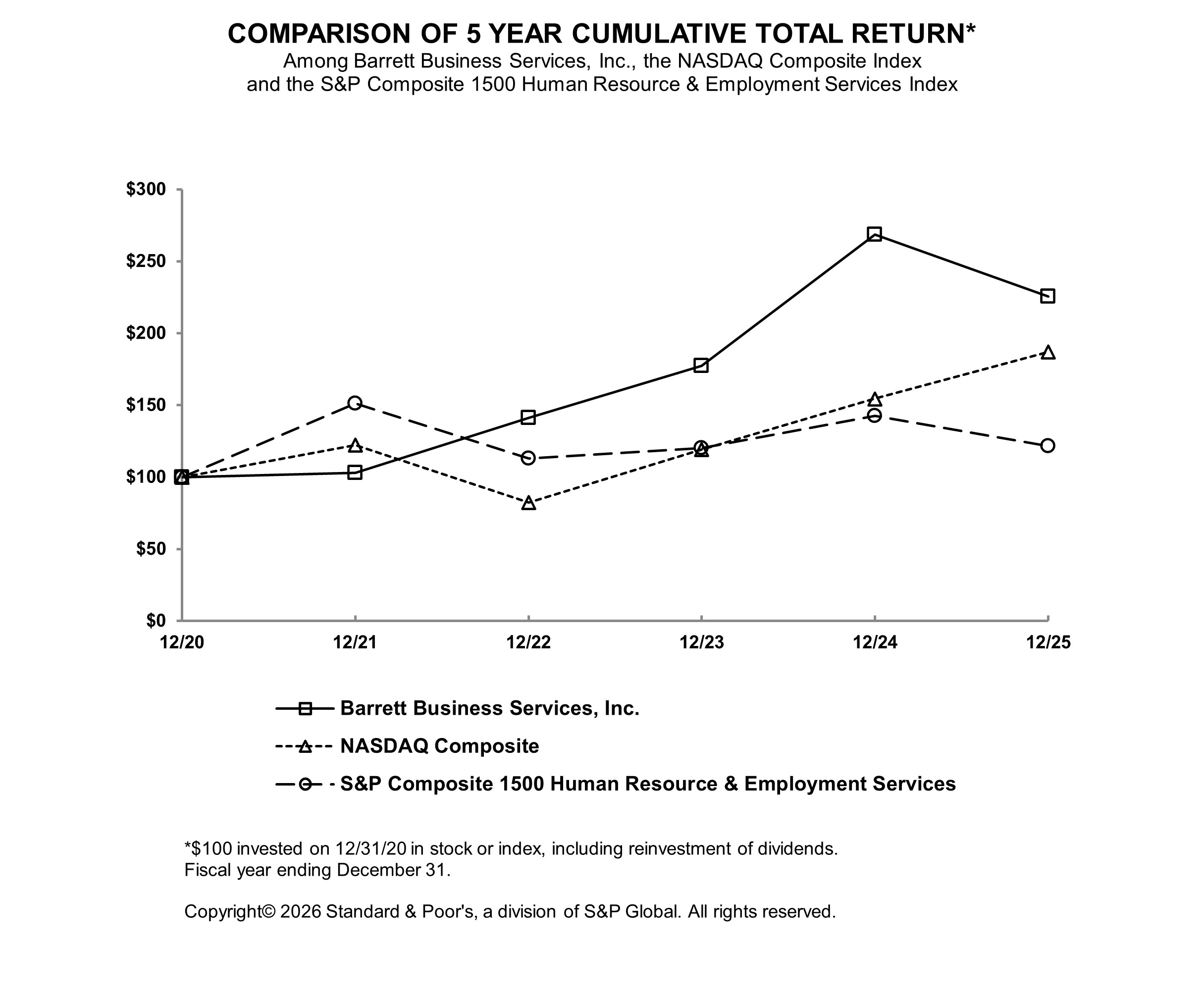
|
|
12/20 |
12/21 |
12/22 |
12/23 |
12/24 |
12/25 |
|
|
|
|
|
|
|
|
Barrett Business Services, Inc. |
|
100.00 |
102.90 |
141.05 |
177.40 |
268.62 |
225.69 |
NASDAQ Composite |
|
100.00 |
122.18 |
82.43 |
119.22 |
154.48 |
187.14 |
S&P 1500 Human Resource & Employment Services Index |
100.00 |
151.14 |
112.90 |
120.20 |
142.72 |
121.68 |
|
26
Item 7. MANAGEMENT'S DISCUSSION AND ANALYSIS OF FINANCIAL CONDITION AND RESULTS OF OPERATIONS
Overview
The Company is a leading provider of business management solutions for small and mid-sized companies. The Company has developed a management platform that integrates a knowledge-based approach from the management consulting industry with tools from the human resource outsourcing industry. This platform, through the effective leveraging of human capital, helps our business owner clients run their businesses more effectively. We believe this platform, delivered through a decentralized organizational structure, differentiates BBSI from our competitors.
We report revenues in our financial results in two categories of services: professional employer services (“PEO”) and staffing.
With our PEO clients, we enter into a co-employment arrangement in which we become the administrative employer while the client maintains physical care, custody and control of their workforce. Our PEO services are billed as a percentage of client payroll; the gross amount invoiced includes direct payroll costs and employee benefits coverage (if provided), plus an additional percentage amount to cover employer payroll-related taxes, workers’ compensation coverage (if provided), other service-related costs and a margin. However, actual costs can be higher or lower than anticipated. PEO customers are invoiced following the end of each payroll processing cycle, with payment generally due on the invoice date. Revenues for PEO services exclude direct payroll billings because we are not the primary obligor for those payments.
We generate staffing services revenues primarily from short-term staffing, contract staffing, on-site management and direct placement services. For staffing services other than direct placement, invoiced amounts include direct payroll, an amount intended to cover employer payroll-related taxes, workers’ compensation coverage, other service-related costs and a margin. Staffing customers are typically invoiced weekly and generally have payment terms of 30 days. Direct placement services are billed at agreed fees at the time of a successful placement.
Our business is concentrated in California, and we expect to continue to derive a majority of our revenues from this market in the future. Revenues generated in our California operations accounted for 72% of our total revenues in each of 2025, 2024 and 2023. Consequently, weakness in economic conditions, changes in the regulatory or insurance environment, or natural disasters or other major disruptive events in California could have a material adverse effect on our financial results.
Our cost of revenues for PEO services includes employer payroll-related taxes, workers’ compensation costs and employee benefits costs. Our cost of revenues for staffing services includes direct payroll costs, employer payroll-related taxes, and workers’ compensation costs. Direct payroll costs represent the gross payroll earned by staffing services employees based on salary or hourly wages. Payroll taxes and benefits consist of the employer’s portion of Social Security and Medicare taxes, federal and state unemployment taxes, and employee benefit costs, which primarily comprise health insurance premiums paid to third-party insurers and underwriting and benefit consultant payroll. Workers’ compensation costs consist primarily of premiums paid to third-party insurers, claims reserves, third-party broker commissions, risk manager payroll, claims administration fees, legal fees, medical cost containment (“MCC”) expense, state administrative agency fees, as well as costs associated with operating our two wholly owned insurance companies, Associated Insurance Company for Excess (“AICE”) and Ecole Insurance Company (“Ecole”).
Selling, general and administrative expenses consist primarily of payroll and personnel related costs, incentive compensation, information systems costs, rent and professional and legal fees.
Depreciation and amortization represent depreciation of property and equipment, leasehold improvements and internally developed software costs. Property, equipment and internally developed software costs are depreciated using the straight-line method over their estimated useful lives, which range from 3 to 39 years. Leasehold improvements are amortized using the straight-line method over the shorter of the lease term or estimated useful life.
27
Critical Accounting Estimate
We have identified the following accounting estimate as critical to our business and the understanding of our results of operations. For a detailed discussion of the application of this and other accounting policies, see “Note 1 - Summary of Operations and Significant Accounting Policies” to the consolidated financial statements in Item 8 of Part II of this report. The preparation of this Annual Report on Form 10-K requires management to make estimates and assumptions that affect the reported amounts of assets and liabilities at the date of the financial statements, and the reported amounts of revenue and expenses during the reporting period. Management bases its estimates on historical experience and on various other assumptions that are believed to be reasonable under the circumstances, the results of which form the basis for making judgments about the carrying values of assets and liabilities that are not readily apparent from other sources. Actual results may differ from these estimates.
Workers' Compensation Costs
Under the Company’s workers’ compensation programs, we estimate ultimate losses, which represent the amount necessary to pay claims and related expenses associated with workplace injuries that have occurred under the programs.
When a claim involving a probable loss is reported, our independent third-party administrator for workers’ compensation claims (“TPA”) establishes a case reserve for the estimated amount of ultimate loss. The estimate reflects a judgment based on established case reserving practices and the experience and knowledge of the TPA regarding the nature and expected amount of the claim, as well as the estimated expenses of settling the claim, including legal and other fees and expenses of claims administration. The adequacy of such case reserves depends in part on the professional judgment of the TPA to evaluate the economic consequences of each claim properly and comprehensively.
Our estimate of ultimate losses includes an additional component for potential future increases in the cost to finally resolve open injury claims and claims incurred in prior periods but not reported (together, "IBNR") based on actuarial estimates provided by the Company’s independent actuary. IBNR does not apply to a specific claim but rather applies to the entire population of claims arising from a specific time period. IBNR primarily covers costs relating to:
The process of estimating claims and claims adjustment expense involves a high degree of judgment and is affected by both internal and external events, including changes in claims handling practices, modifications in reserve estimation procedures, changes in individuals involved in the reserve estimation process, inflation, trends in the litigation and settlement of pending claims, and legislative changes.
Our estimates are based on actuarial analyses and informed judgment, derived from individual experience and expertise applied to multiple sets of data and analyses. We consider significant facts and circumstances known both at the time that loss reserves are initially established and as new facts and circumstances become known. Due to the inherent uncertainty underlying loss estimates, the ultimate expense incurred will likely vary from the related loss estimate at the reporting date. Therefore, as specific claims are paid out in the future, actual paid losses may be materially different from our current loss estimates.
A basic premise in most actuarial analyses is that historical data and past patterns demonstrated in the incurred and paid historical data form a reasonable basis upon which to project future outcomes, absent a material change. Significant structural changes to the available data can materially impact the estimation process. To the extent a material change affecting the ultimate claim amount becomes known, such change is quantified to the extent possible through an analysis of internal company data and, if available and when appropriate, external data. Actuaries exercise a considerable degree of judgment in the evaluation of these factors and the need for such actuarial judgment is more pronounced when faced with material uncertainties.
28
For claims incurred under the Company's self-insured programs, we record reserves equal to our estimate of the ultimate losses up to the retention limit, reduced by claim payments made.
Third-party insurers assume substantially all risk of loss for claims incurred under the Company's fully insured arrangement. However, the Company's fully insured policies allow for return premiums if claims develop favorably, ranging from $20.0 million to $30.0 million depending on the policy period. For the policy period beginning July 1, 2021, BBSI can incur additional premiums up to $7.5 million if claims develop adversely. For all other policy years, no additional premiums can be charged based on claim performance. Our estimate of the losses associated with claims incurred under the fully insured policies directly impacts our estimate of the return premiums we may realize or the additional premiums that we may incur.
The estimate we recorded for workers’ compensation costs was reduced by $18.7 million and $18.5 million in 2025 and 2024, respectively, due to changes in estimated losses for prior accident years.
We believe that the amounts that we have recorded for our estimated workers’ compensation costs are reasonable. Nevertheless, adjustments to such estimates will be required in future periods if the development of claim costs varies materially from our estimates, and such future adjustments may be material to our results of operations.
To illustrate the sensitivity of changes in our estimate of workers’ compensation costs, a 5% increase in estimated ultimate losses for the 2025 accident year would result in a $0.6 million increase in workers’ compensation expense, and a 5% decrease in estimated ultimate losses for the 2025 accident year would result in a $7.5 million decrease to workers’ compensation expense. This asymmetric impact on workers’ compensation expense is due to our insured program, which limits our expense if claim costs increase but passes through savings if claim costs are lower than expected.
Recent Accounting Pronouncements
For a discussion of recent accounting pronouncements and their potential effect on the Company's results of operations and financial condition, see “Note 1 - Summary of Operations and Significant Accounting Policies” to the consolidated financial statements in Item 8 of Part II of this report.
Forward-Looking Information
Statements in this Annual Report on Form 10-K include forward-looking statements, which are not historical in nature and are forward-looking statements within the meaning of the Private Securities Litigation Reform Act of 1995. These forward-looking statements include, among others, discussion of economic conditions in our market areas, especially in California, and their effect on revenue levels; the competitiveness of our service offerings; the availability of certain fully insured medical and other health and welfare benefits to qualifying worksite employees; our ability to attract and retain clients and to achieve revenue growth; the effect of changes in our mix of services on gross margin; labor market conditions, including the impact of AI and automation on workplace displacement; the adequacy of our workers' compensation reserves; the effect of changes in estimates of our future claims liabilities on our workers’ compensation reserves, including the effect of changes in our reserving practices and claims management process on our actuarial estimates; expected levels of required surety deposits and letters of credit; the outcome of audits; the effect of our formation and operation of two wholly owned licensed insurance subsidiaries; the risks of operation and cost of our insured program; the financial viability of our excess insurance carriers; the effectiveness of our management information systems; our relationship with our primary bank lender and the availability of financing and working capital to meet our funding requirements; litigation costs; the effect of inflationary pressures or changes in the interest rate environment on the value of our investment securities; the adequacy of our allowance for expected credit losses; and the potential for and effect of acquisitions.
All our forward-looking statements involve known and unknown risks, uncertainties and other factors that may cause the actual results, performance or achievements of the Company to be materially different from any future results, performance or achievements expressed or implied by such forward-looking statements. Such factors with respect to the Company include: our ability to retain current clients and
29
attract new clients; technology disruption, including the displacement of employees through the adoption of AI and automation by our clients; difficulties associated with integrating clients into our operations; economic trends in our service areas and the potential effects of changing governmental policies, including those related to immigration, tariffs, other trade policies, or climate regulation; risks to our business and the business of our clients arising from current or future tariffs or other trade restrictions, supply chain issues, changes in labor force, or geopolitical instability, including the war in Ukraine, conflicts in the Middle East, and the potential for future conflicts or disruptions in other parts of the world; natural disasters; the potential for material deviations from expected future workers’ compensation claims experience; changes in the workers’ compensation regulatory environment in our primary markets; PEO client benefit costs, particularly with regard to health insurance benefits; security breaches or failures in the Company’s information technology systems; collectability of accounts receivable; changes in executive management; changes in effective payroll tax rates and federal and state income tax rates; the carrying values of deferred income tax assets and goodwill (which may be affected by our future operating results); the effects of inflation on our operating expenses and those of our clients; the impact of and potential changes to the Patient Protection and Affordable Care Act, escalating medical costs, and other health care legislative initiatives on our business; the effect of changing monetary policy, interest rates and conditions in the global capital markets on our investment portfolio; and the availability of capital, borrowing capacity on our revolving credit facility, or letters of credit necessary to meet state-mandated surety deposit requirements for maintaining our status as a qualified self-insured employer for workers' compensation coverage or our insured program. Additional risk factors affecting our business are discussed in Item 1A of Part I of this report. We disclaim any obligation to publicly announce any revisions to any of the forward-looking statements contained herein to reflect future events or developments.
Results of Operations
The following table sets forth the percentages of total revenues represented by selected items in the Company's consolidated statements of operations for the years ended December 31, 2025, 2024 and 2023, included in Item 8 of Part II of this report.
|
|
Percentage of Total Net Revenues |
|
|
|||||||||||||||||||||||
($ in thousands) |
|
Years Ended December 31, |
|
|
|||||||||||||||||||||||
|
|
2025 |
|
|
|
2024 |
|
|
|
2023 |
|
|
|||||||||||||||
Revenues: |
|
|
|
|
|
|
|
|
|
|
|
|
|
|
|
|
|
|
|
|
|
||||||
Professional employer services |
|
$ |
1,168,334 |
|
|
|
94.2 |
|
% |
|
$ |
1,063,386 |
|
|
|
92.9 |
|
% |
|
$ |
982,268 |
|
|
|
91.9 |
|
% |
Staffing services |
|
|
71,964 |
|
|
|
5.8 |
|
|
|
|
81,145 |
|
|
|
7.1 |
|
|
|
|
87,039 |
|
|
|
8.1 |
|
|
Total revenues |
|
|
1,240,298 |
|
|
|
100.0 |
|
|
|
|
1,144,531 |
|
|
|
100.0 |
|
|
|
|
1,069,307 |
|
|
|
100.0 |
|
|
Cost of revenues: |
|
|
|
|
|
|
|
|
|
|
|
|
|
|
|
|
|
|
|
|
|
||||||
Direct payroll costs |
|
|
54,443 |
|
|
|
4.4 |
|
|
|
|
61,010 |
|
|
|
5.3 |
|
|
|
|
65,042 |
|
|
|
6.1 |
|
|
Payroll taxes and benefits |
|
|
720,798 |
|
|
|
58.1 |
|
|
|
|
628,534 |
|
|
|
54.9 |
|
|
|
|
555,758 |
|
|
|
52.0 |
|
|
Workers’ compensation |
|
|
204,144 |
|
|
|
16.5 |
|
|
|
|
201,736 |
|
|
|
17.6 |
|
|
|
|
205,975 |
|
|
|
19.2 |
|
|
Total cost of revenues |
|
|
979,385 |
|
|
|
79.0 |
|
|
|
|
891,280 |
|
|
|
77.8 |
|
|
|
|
826,775 |
|
|
|
77.3 |
|
|
Gross margin |
|
|
260,913 |
|
|
|
21.0 |
|
|
|
|
253,251 |
|
|
|
22.2 |
|
|
|
|
242,532 |
|
|
|
22.7 |
|
|
Selling, general and administrative |
|
|
190,494 |
|
|
|
15.4 |
|
|
|
|
185,869 |
|
|
|
16.2 |
|
|
|
|
174,772 |
|
|
|
16.3 |
|
|
Depreciation and amortization |
|
|
8,256 |
|
|
|
0.7 |
|
|
|
|
7,601 |
|
|
|
0.7 |
|
|
|
|
7,110 |
|
|
|
0.7 |
|
|
Income from operations |
|
|
62,163 |
|
|
|
4.9 |
|
|
|
|
59,781 |
|
|
|
5.3 |
|
|
|
|
60,650 |
|
|
|
5.7 |
|
|
Other income, net |
|
|
9,236 |
|
|
|
0.7 |
|
|
|
|
11,041 |
|
|
|
1.0 |
|
|
|
|
8,338 |
|
|
|
0.8 |
|
|
Income before income taxes |
|
|
71,399 |
|
|
|
5.6 |
|
|
|
|
70,822 |
|
|
|
6.3 |
|
|
|
|
68,988 |
|
|
|
6.5 |
|
|
Provision for income taxes |
|
|
16,951 |
|
|
|
1.4 |
|
|
|
|
17,829 |
|
|
|
1.6 |
|
|
|
|
18,376 |
|
|
|
1.7 |
|
|
Net income |
|
$ |
54,448 |
|
|
|
4.2 |
|
% |
|
$ |
52,993 |
|
|
|
4.7 |
|
% |
|
$ |
50,612 |
|
|
|
4.8 |
|
% |
30
We report PEO revenues net of direct payroll costs because we are not the primary obligor for wage payments to our clients’ employees. However, management believes that gross billings and wages are useful in understanding the volume of our business activity and serve as an important performance metric in managing our operations, including the preparation of internal operating forecasts and establishing executive compensation performance goals. We therefore present for purposes of analysis gross billings and wage information for the years ended December 31, 2025, 2024 and 2023.
|
Year Ended |
|
|||||||||
|
December 31, |
|
|||||||||
(in thousands) |
2025 |
|
|
2024 |
|
|
2023 |
|
|||
Gross billings |
$ |
9,042,132 |
|
|
$ |
8,327,091 |
|
|
$ |
7,716,152 |
|
PEO and staffing wages |
$ |
7,856,320 |
|
|
$ |
7,245,093 |
|
|
$ |
6,711,115 |
|
In monitoring and evaluating the performance of our operations, management also reviews the following ratios, which represent selected amounts as a percentage of gross billings. Management believes these ratios are useful in understanding the efficiency and profitability of our service offerings.
|
Percentage of Gross Billings |
|
|||||||||
|
Year Ended |
|
|||||||||
|
December 31, |
|
|||||||||
|
2025 |
|
|
2024 |
|
|
2023 |
|
|||
PEO and staffing wages |
|
86.9 |
% |
|
|
87.0 |
% |
|
|
87.0 |
% |
Payroll taxes and benefits |
|
7.9 |
% |
|
|
7.6 |
% |
|
|
7.2 |
% |
Workers' compensation |
|
2.3 |
% |
|
|
2.4 |
% |
|
|
2.7 |
% |
Gross margin |
|
2.9 |
% |
|
|
3.0 |
% |
|
|
3.1 |
% |
We refer to employees of our PEO clients as worksite employees (“WSEs”). Management reviews average and ending WSE growth to monitor and evaluate the performance of our operations. Average WSEs are calculated by dividing the number of unique individuals paid in each month by the number of months in the period. Ending WSEs represents the number of unique individuals paid in the last month of the period.
|
Year Ended |
|
|||||||||||||||||
|
December 31, |
|
|||||||||||||||||
|
2025 |
|
|
Year-over-year |
|
|
2024 |
|
|
Year-over-year |
|
|
2023 |
|
|||||
Average WSEs |
|
138,218 |
|
|
|
6.7 |
% |
|
|
129,577 |
|
|
|
4.2 |
% |
|
|
124,306 |
|
Ending WSEs |
|
138,605 |
|
|
|
4.9 |
% |
|
|
132,069 |
|
|
|
4.4 |
% |
|
|
126,446 |
|
31
Years Ended December 31, 2025 and 2024
Net income for 2025 was $54.4 million compared to net income of $53.0 million for 2024. Diluted net income per share for 2025 was $2.08 compared to diluted income per share of $1.98 for 2024.
Revenue for 2025 totaled $1,240.3 million, an increase of $95.8 million or 8.4% over 2024, which reflects an increase in the Company’s PEO service revenue of $104.9 million or 9.9% and a decrease in staffing services revenue of $9.2 million or 11.3%.
The increase in PEO services revenues was primarily attributable to a 6.7% increase in average number of WSEs as well as a 2.4% increase in average billing per WSE per day.
Gross margin for 2025 totaled $260.9 million or 21.0% of revenue compared to $253.3 million or 22.2% of revenue for 2024. The decrease in gross margin as a percentage of revenues is primarily a result of the factors discussed within the separate components of gross margin below.
Direct payroll costs for 2025 totaled $54.4 million or 4.4% of revenue compared to $61.0 million or 5.3% of revenue for 2024. The decrease in direct payroll costs as a percentage of revenues was primarily due to a decrease in staffing services within the mix of our customer base in 2025 as compared to 2024.
Payroll taxes and benefits for 2025 totaled $720.8 million or 58.1% of revenue compared to $628.5 million or 54.9% of revenue for 2024. The increase in payroll taxes and benefits expense as a percentage of revenue was primarily due to higher average payroll tax rates in 2025 and PEO client benefit costs of $75.6 million in 2025 compared to $33.4 million in 2024.
Workers’ compensation expense for 2025 totaled $204.1 million or 16.5% of revenue compared to $201.7 million or 17.6% of revenue for 2024. The decrease in workers’ compensation expense as a percentage of revenue was primarily due to lower workers' compensation costs in the current year, which included favorable prior year liability and premium adjustments of $18.7 million in 2025, compared to favorable prior year liability and premium adjustments of $18.5 million in 2024.
Selling, general and administrative (“SG&A”) expenses for 2025 totaled $190.5 million or 15.4% of revenue compared to $185.9 million or 16.2% of revenue for 2024. The increase of $4.6 million in SG&A expense was primarily attributable to increased employee-related costs.
Other income, net for 2025 totaled $9.2 million compared to other income of $11.0 million for 2024. The decrease was primarily attributable to a decrease in investment income in 2025.
Our effective income tax rate for 2025 was 23.7% compared to 25.2% for 2024. Our income tax rate typically differs from the federal statutory tax rate of 21% primarily due to state taxes as well as federal and state tax credits. See “Note 8 - Income Taxes” to the consolidated financial statements included in Item 8 of Part II of this report for additional information regarding income taxes.
A discussion of our financial condition and results of operations for 2024 compared to 2023 can be found in Part II, Item 7. Management's Discussion and Analysis in our Annual Report on Form 10-K for the year ended December 31, 2024, filed with the SEC on February 28, 2025.
32
Fluctuations in Quarterly Operating Results
We historically have experienced significant fluctuations in our quarterly operating results, including losses or minimal income in the first quarter of each year, and expect such fluctuations to continue in the future. Our operating results may fluctuate due to a number of factors such as seasonality, wage limits on statutory payroll taxes, claims experience for workers’ compensation, demand for our services, and competition. Payroll taxes, as a component of cost of revenues, generally decline throughout a calendar year as the applicable statutory wage bases for federal and state unemployment taxes and Social Security taxes are exceeded on a per employee basis. Our revenue levels may be higher in the third quarter due to the effect of increased business activity of our customers’ businesses in the agriculture, food processing and forest products-related industries. In addition, revenues in the fourth quarter may be reduced by many customers’ practice of operating on holiday-shortened schedules. Workers’ compensation expense varies with both the frequency and severity of workplace injury claims reported during a quarter and the estimated future costs of such claims. Positive or adverse loss development of prior period claims during a subsequent quarter may also contribute to the volatility in the Company’s estimated workers’ compensation expense.
Liquidity and Capital Resources
The Company's cash balance of $126.3 million at December 31, 2025, which includes cash, cash equivalents, and restricted cash, increased $43.7 million for the twelve months ended December 31, 2025, compared to the cash balance of $82.6 million at December 31, 2024, with an increase of $7.7 million compared to 2024. The increase in cash at December 31, 2025 as compared to December 31, 2024 was primarily due to the factors discussed below.
Net cash provided by operating activities in 2025 amounted to $66.0 million, compared to net cash provided by operating activities of $10.1 million for the comparable period of 2024. In 2025, net cash provided by operating activities was primarily due to net income of $54.4 million, increased accrued payroll and related benefits of $22.6 million, increased payroll taxes payable of $12.8 million, share-based compensation of $10.4 million, increased other accrued liabilities of $8.8 million and depreciation and amortization of $8.3 million, partially offset by decreased workers’ compensation claims liabilities of $23.6 million, decreased premium payable of $16.0 million and increased trade accounts receivable of $14.1 million.
Net cash provided by investing activities totaled $30.8 million in 2025, compared to net cash provided by investing activities of $38.8 million for the comparable period of 2024. In 2025, net cash provided by investing activities consisted primarily of proceeds from the sale and maturity of investments and restricted investments of $93.6 million, partially offset by the purchases of investments and restricted investments of $44.0 million and the purchase of property, equipment and software of $18.8 million.
Net cash used in financing activities in 2025 was $53.0 million compared to net cash used in financing activities of $41.1 million for the comparable period of 2024. In 2025, net cash used in financing activities primarily consisted of repurchases of common stock of $42.0 million and dividend payments of $8.2 million.
The Company is required to maintain minimum collateral levels for certain policies issued under the insured program, which is held in a trust account (the “trust account”). The balance in the trust account was $175.3 million and $197.1 million at December 31, 2025 and December 31, 2024, respectively. The trust account balance is included as a component of the current and long-term restricted cash and investments in the Company’s consolidated balance sheets.
See “Note 5 - Revolving Credit Facility” to the consolidated financial statements included in Item 8 of Part II of this report for information regarding the Company’s credit agreement with Wells Fargo Bank, N.A.
33
Contractual Obligations
The Company's contractual obligations as of December 31, 2025 are summarized below:
|
|
As of December 31, 2025 |
|
|||||||||||||||||
|
|
Payments Due by Period |
|
|||||||||||||||||
(in thousands) |
|
|
|
|
Less than |
|
|
1 - 3 |
|
|
4 - 5 |
|
|
After |
|
|||||
|
|
Total |
|
|
1 Year |
|
|
Years |
|
|
Years |
|
|
5 Years |
|
|||||
Operating leases (1) |
|
$ |
27,516 |
|
|
$ |
8,164 |
|
|
$ |
12,135 |
|
|
$ |
5,159 |
|
|
$ |
2,058 |
|
Total contractual obligations |
|
$ |
27,516 |
|
|
$ |
8,164 |
|
|
$ |
12,135 |
|
|
$ |
5,159 |
|
|
$ |
2,058 |
|
(1) As of December 31, 2025, the Company had no additional operating leases that have not yet commenced and remaining balances on short-term operating leases of $0.2 million, included in the table above. The Company has no long-term debt obligations as of December 31, 2025.
Item 7A. QUANTITATIVE AND QUALITATIVE DISCLOSURES ABOUT MARKET RISK
The Company's exposure to market risk for changes in interest rates primarily relates to its investment portfolio and outstanding borrowings on its line of credit. The Company's investments and restricted investments, which are classified as available-for-sale, consist primarily of fixed-rate debt securities, the fair value of which fluctuates with prevailing interest rates. Our cash equivalents consist primarily of money market funds, which are not meaningfully impacted by interest rate risk. We attempt to limit our investment portfolio's exposure to market risk through low investment turnover and diversification. Based on the Company's overall interest exposure at December 31, 2025, a 50-basis-point increase in market interest rates would have a $3.2 million downward effect on the fair value of the Company's investment portfolio. Outstanding borrowings on the Company's line of credit bear interest at a variable market rate, which makes the cost of borrowing on the line of credit susceptible to changing interest rates. At December 31, 2025, the Company had no outstanding borrowings on its line of credit.
34
Item 8. FINANCIAL STATEMENTS AND SUPPLEMENTARY DATA
REPORT OF INDEPENDENT REGISTERED PUBLIC ACCOUNTING FIRM
To the stockholders and the Board of Directors of
Barrett Business Services, Inc.
Opinion on the Financial Statements
We have audited the accompanying consolidated balance sheets of Barrett Business Services, Inc. and subsidiaries (the “Company”) as of December 31, 2025 and 2024, the related consolidated statements of operations, comprehensive income, stockholders' equity, and cash flows, for each of the three years in the period ended December 31, 2025, and the related notes (collectively referred to as the "financial statements"). In our opinion, the financial statements present fairly, in all material respects, the financial position of the Company as of December 31, 2025 and 2024, and the results of its operations and its cash flows for each of the three years in the period ended December 31, 2025, in conformity with accounting principles generally accepted in the United States of America.
We have also audited, in accordance with the standards of the Public Company Accounting Oversight Board (United States) (PCAOB), the Company's internal control over financial reporting as of December 31, 2025, based on criteria established in Internal Control — Integrated Framework (2013) issued by the Committee of Sponsoring Organizations of the Treadway Commission and our report dated February 25, 2026, expressed an unqualified opinion on the Company's internal control over financial reporting.
Basis for Opinion
These financial statements are the responsibility of the Company's management. Our responsibility is to express an opinion on the Company's financial statements based on our audits. We are a public accounting firm registered with the PCAOB and are required to be independent with respect to the Company in accordance with the U.S. federal securities laws and the applicable rules and regulations of the Securities and Exchange Commission and the PCAOB.
We conducted our audits in accordance with the standards of the PCAOB. Those standards require that we plan and perform the audit to obtain reasonable assurance about whether the financial statements are free of material misstatement, whether due to error or fraud. Our audits included performing procedures to assess the risks of material misstatement of the financial statements, whether due to error or fraud, and performing procedures that respond to those risks. Such procedures included examining, on a test basis, evidence regarding the amounts and disclosures in the financial statements. Our audits also included evaluating the accounting principles used and significant estimates made by management, as well as evaluating the overall presentation of the financial statements. We believe that our audits provide a reasonable basis for our opinion.
Critical Audit Matter
The critical audit matter communicated below is a matter arising from the current-period audit of the financial statements that was communicated or required to be communicated to the audit committee and that (1) relates to accounts or disclosures that are material to the financial statements and (2) involved our especially challenging, subjective, or complex judgments. The communication of critical audit matters does not alter in any way our opinion on the financial statements, taken as a whole, and we are not, by communicating the critical audit matter below, providing a separate opinion on the critical audit matter or on the accounts or disclosures to which it relates.
35
Workers’ Compensation Costs
Under the Company’s workers’ compensation programs management estimates ultimate losses, which represent the amount necessary to pay claims and related expenses associated with workplace injuries that have occurred under the programs.
These estimates utilize actuarial expertise and projection techniques at a given reporting date, and are based on an evaluation of information provided by the Company’s third-party administrator for workers’ compensation claims, coupled with an actuarial estimate of future loss development with respect to reported claims and incurred but not reported claims (together, “IBNR”). The Company’s estimates are based on actuarial analysis and informed judgment, derived from individual experience and expertise applied to multiple sets of data and analyses. The Company considers significant facts and circumstances known both at the time that loss estimates are initially established, and as new facts and circumstances become known.
Given the subjectivity of estimating future loss development with respect to reported claims and incurred but not reported claims, the related audit procedures to evaluate the ultimate incurred losses required a high degree of auditor judgment and an increased extent of effort, including involvement of our actuarial specialists.
For claims incurred under the Company’s self-insured programs, the Company records reserves equal to their estimate of the ultimate losses up to the retention limit, reduced by claim payments made.
The Company’s fully insured policies allow for return premiums if claims develop favorably, ranging from $20.0 million to $30.0 million, depending on the policy period. For the policy period beginning July 1, 2021, the Company can incur additional premiums up to $7.5 million if claims develop adversely. For all other policy years, no additional premiums can be charged based on claim performance. The estimate of the losses associated with claims incurred under the fully insured policies directly impacts the estimate of the return premiums the Company may realize or the additional premiums that they may incur.
How the Critical Audit Matter Was Addressed in the Audit
Our audit procedures related to the ultimate loss estimates included the following:
/s/
February 25, 2026
We have served as the Company's auditor since 2016.
36
Barrett Business Services, Inc.
Consolidated Balance Sheets
December 31, 2025 and 2024
(In Thousands, Except Par Value)
|
|
December 31, |
|
|
December 31, |
|
||
|
|
2025 |
|
|
2024 |
|
||
ASSETS |
|
|
|
|
|
|
||
Current assets: |
|
|
|
|
|
|
||
Cash and cash equivalents |
|
$ |
|
|
$ |
|
||
Investments |
|
|
|
|
|
|
||
Trade accounts receivable, net |
|
|
|
|
|
|
||
Income taxes receivable |
|
|
|
|
|
|
||
Prepaid expenses and other |
|
|
|
|
|
|
||
Restricted cash and investments |
|
|
|
|
|
|
||
Total current assets |
|
|
|
|
|
|
||
Property, equipment and software, net |
|
|
|
|
|
|
||
Operating lease right-of-use assets |
|
|
|
|
|
|
||
Restricted cash and investments |
|
|
|
|
|
|
||
Goodwill |
|
|
|
|
|
|
||
Other assets |
|
|
|
|
|
|
||
Deferred income taxes |
|
|
|
|
|
|
||
Total assets |
|
$ |
|
|
$ |
|
||
LIABILITIES AND STOCKHOLDERS' EQUITY |
|
|
|
|
|
|
||
Current liabilities: |
|
|
|
|
|
|
||
Accounts payable |
|
$ |
|
|
$ |
|
||
Accrued payroll and related benefits |
|
|
|
|
|
|
||
Payroll taxes payable |
|
|
|
|
|
|
||
Current operating lease liabilities |
|
|
|
|
|
|
||
Current premium payable |
|
|
|
|
|
|
||
Other accrued liabilities |
|
|
|
|
|
|
||
Workers' compensation claims liabilities |
|
|
|
|
|
|
||
Total current liabilities |
|
|
|
|
|
|
||
Long-term workers' compensation claims liabilities |
|
|
|
|
|
|
||
Long-term premium payable |
|
|
|
|
|
|
||
Long-term operating lease liabilities |
|
|
|
|
|
|
||
Customer deposits and other long-term liabilities |
|
|
|
|
|
|
||
Total liabilities |
|
|
|
|
|
|
||
(Notes 5, 7 and 11) |
|
|
|
|
|
|
||
Stockholders' equity: |
|
|
|
|
|
|
||
Common stock, $ |
|
|
|
|
|
|
||
Additional paid-in capital |
|
|
|
|
|
|
||
Accumulated other comprehensive loss |
|
|
( |
) |
|
|
( |
) |
Retained earnings |
|
|
|
|
|
|
||
Total stockholders' equity |
|
|
|
|
|
|
||
Total liabilities and stockholders' equity |
|
$ |
|
|
$ |
|
||
The accompanying notes are an integral part of these consolidated financial statements.
37
Barrett Business Services, Inc.
Consolidated Statements of Operations
Years Ended December 31, 2025, 2024 and 2023
(In Thousands, Except Per Share Amounts)
|
Year Ended |
|
|||||||
|
December 31, |
|
|||||||
|
2025 |
|
2024 |
|
2023 |
|
|||
Revenues: |
|
|
|
|
|
|
|||
Professional employer services |
$ |
|
$ |
|
$ |
|
|||
Staffing services |
|
|
|
|
|
|
|||
Total revenues |
|
|
|
|
|
|
|||
Cost of revenues: |
|
|
|
|
|
|
|||
Direct payroll costs |
|
|
|
|
|
|
|||
Payroll taxes and benefits |
|
|
|
|
|
|
|||
Workers' compensation |
|
|
|
|
|
|
|||
Total cost of revenues |
|
|
|
|
|
|
|||
Gross margin |
|
|
|
|
|
|
|||
Selling, general and administrative expenses |
|
|
|
|
|
|
|||
Depreciation and amortization |
|
|
|
|
|
|
|||
Income from operations |
|
|
|
|
|
|
|||
Other income (expense): |
|
|
|
|
|
|
|||
Investment income, net |
|
|
|
|
|
|
|||
Interest expense |
|
( |
) |
|
( |
) |
|
( |
) |
Other, net |
|
|
|
|
|
( |
) |
||
Other income, net |
|
|
|
|
|
|
|||
Income before income taxes |
|
|
|
|
|
|
|||
Provision for income taxes |
|
|
|
|
|
|
|||
Net income |
$ |
|
$ |
|
$ |
|
|||
Basic income per common share |
$ |
|
$ |
|
$ |
|
|||
Weighted average number of basic common shares outstanding |
|
|
|
|
|
|
|||
Diluted income per common share |
$ |
|
$ |
|
$ |
|
|||
Weighted average number of diluted common shares outstanding |
|
|
|
|
|
|
|||
The accompanying notes are an integral part of these consolidated financial statements.
38
Barrett Business Services, Inc.
Consolidated Statements of Comprehensive Income
Years Ended December 31, 2025, 2024 and 2023
(In Thousands)
|
|
Year Ended |
|
|||||||||
|
|
December 31, |
|
|||||||||
|
|
2025 |
|
|
2024 |
|
|
2023 |
|
|||
Net income |
|
$ |
|
|
$ |
|
|
$ |
|
|||
Unrealized gains on investments, net of tax of $ |
|
|
|
|
|
|
|
|
|
|||
Comprehensive income |
|
$ |
|
|
$ |
|
|
$ |
|
|||
The accompanying notes are an integral part of these consolidated financial statements.
39
Barrett Business Services, Inc.
Consolidated Statements of Stockholders' Equity
Years Ended December 31, 2025, 2024 and 2023
(In Thousands)
|
|
|
|
|
|
|
|
|
|
|
|
|
|
|
|
|
|
||||||
|
|
|
|
|
|
|
|
|
|
Accumulated |
|
|
|
|
|
|
|
||||||
|
|
|
|
|
|
|
Additional |
|
|
Other |
|
|
|
|
|
|
|
||||||
|
Common Stock |
|
|
Paid-in |
|
|
Comprehensive |
|
|
Retained |
|
|
|
|
|||||||||
|
Shares |
|
|
Amount |
|
|
Capital |
|
|
Loss |
|
|
Earnings |
|
|
Total |
|
||||||
Balance, December 31, 2022 |
|
|
|
$ |
|
|
$ |
|
|
$ |
( |
) |
|
$ |
|
|
$ |
|
|||||
Common stock issued on exercise of options, |
|
|
|
|
|
|
|
|
|
|
— |
|
|
|
— |
|
|
|
|
||||
Common stock repurchased on vesting of |
|
( |
) |
|
|
( |
) |
|
|
( |
) |
|
|
— |
|
|
|
— |
|
|
|
( |
) |
Share-based compensation expense |
|
— |
|
|
|
— |
|
|
|
|
|
|
— |
|
|
|
— |
|
|
|
|
||
Company repurchase of common stock |
|
( |
) |
|
|
( |
) |
|
|
( |
) |
|
|
— |
|
|
|
( |
) |
|
|
( |
) |
Cash dividends on common stock ($ |
|
— |
|
|
|
— |
|
|
|
— |
|
|
|
— |
|
|
|
( |
) |
|
|
( |
) |
Unrealized gain on investments, net of tax |
|
— |
|
|
|
— |
|
|
|
— |
|
|
|
|
|
|
— |
|
|
|
|
||
Net income |
|
— |
|
|
|
— |
|
|
|
— |
|
|
|
— |
|
|
|
|
|
|
|
||
Balance, December 31, 2023 |
|
|
|
$ |
|
|
$ |
|
|
$ |
( |
) |
|
$ |
|
|
$ |
|
|||||
Common stock issued on exercise of options, |
|
|
|
|
|
|
|
|
|
|
— |
|
|
|
— |
|
|
|
|
||||
Common stock repurchased on vesting of |
|
( |
) |
|
|
( |
) |
|
|
( |
) |
|
|
— |
|
|
|
— |
|
|
|
( |
) |
Share-based compensation expense |
|
— |
|
|
|
— |
|
|
|
|
|
|
— |
|
|
|
— |
|
|
|
|
||
Company repurchase of common stock |
|
( |
) |
|
|
( |
) |
|
|
( |
) |
|
|
— |
|
|
|
( |
) |
|
|
( |
) |
Cash dividends on common stock ($ |
|
— |
|
|
|
— |
|
|
|
— |
|
|
|
— |
|
|
|
( |
) |
|
|
( |
) |
Unrealized gain on investments, net of tax |
|
— |
|
|
|
— |
|
|
|
— |
|
|
|
|
|
|
— |
|
|
|
|
||
Net income |
|
— |
|
|
|
— |
|
|
|
— |
|
|
|
— |
|
|
|
|
|
|
|
||
Balance, December 31, 2024 |
|
|
|
$ |
|
|
$ |
|
|
$ |
( |
) |
|
$ |
|
|
$ |
|
|||||
Common stock issued on exercise of options, |
|
|
|
|
|
|
|
|
|
|
— |
|
|
|
— |
|
|
|
|
||||
Common stock repurchased on vesting of |
|
( |
) |
|
|
( |
) |
|
|
( |
) |
|
|
— |
|
|
|
— |
|
|
|
( |
) |
Share-based compensation expense |
|
— |
|
|
|
— |
|
|
|
|
|
|
— |
|
|
|
— |
|
|
|
|
||
Company repurchase of common stock |
|
( |
) |
|
|
( |
) |
|
|
( |
) |
|
|
— |
|
|
|
( |
) |
|
|
( |
) |
Cash dividends on common stock ($ |
|
— |
|
|
|
— |
|
|
|
— |
|
|
|
— |
|
|
|
( |
) |
|
|
( |
) |
Unrealized gain on investments, net of tax |
|
— |
|
|
|
— |
|
|
|
— |
|
|
|
|
|
|
— |
|
|
|
|
||
Net income |
|
— |
|
|
|
— |
|
|
|
— |
|
|
|
— |
|
|
|
|
|
|
|
||
Balance, December 31, 2025 |
|
|
|
$ |
|
|
$ |
|
|
$ |
( |
) |
|
$ |
|
|
$ |
|
|||||
The accompanying notes are an integral part of these consolidated financial statements.
40
Barrett Business Services, Inc.
Consolidated Statements of Cash Flows
Years Ended December 31, 2025, 2024 and 2023
(In Thousands)
|
|
Year Ended |
|
|||||||||
|
|
December 31, |
|
|||||||||
|
|
2025 |
|
|
2024 |
|
|
2023 |
|
|||
Cash flows from operating activities: |
|
|
|
|
|
|
|
|
|
|||
Net income |
|
$ |
|
|
$ |
|
|
$ |
|
|||
Reconciliations of net income to net cash provided by operating activities: |
|
|
|
|
|
|
|
|
|
|||
Depreciation and amortization |
|
|
|
|
|
|
|
|
|
|||
Non-cash operating lease expense |
|
|
|
|
|
|
|
|
|
|||
Investment amortization (accretion) and losses (gains) recognized |
|
|
|
|
|
( |
) |
|
|
|
||
Losses recognized on disposal of property and equipment |
|
|
|
|
|
|
|
|
|
|||
Deferred income taxes |
|
|
|
|
|
( |
) |
|
|
|
||
Share-based compensation |
|
|
|
|
|
|
|
|
|
|||
Changes in certain operating assets and liabilities: |
|
|
|
|
|
|
|
|
|
|||
Trade accounts receivable |
|
|
( |
) |
|
|
( |
) |
|
|
( |
) |
Income taxes |
|
|
( |
) |
|
|
|
|
|
( |
) |
|
Prepaid expenses and other |
|
|
|
|
|
( |
) |
|
|
|
||
Accounts payable |
|
|
|
|
|
|
|
|
( |
) |
||
Accrued payroll and related benefits |
|
|
|
|
|
|
|
|
|
|||
Payroll taxes payable |
|
|
|
|
|
( |
) |
|
|
|
||
Other accrued liabilities |
|
|
|
|
|
( |
) |
|
|
( |
) |
|
Premium payable |
|
|
( |
) |
|
|
|
|
|
|
||
Workers' compensation claims liabilities |
|
|
( |
) |
|
|
( |
) |
|
|
( |
) |
Operating lease liabilities |
|
|
( |
) |
|
|
( |
) |
|
|
( |
) |
Other assets and liabilities, net |
|
|
( |
) |
|
|
|
|
|
( |
) |
|
Net cash provided by operating activities |
|
|
|
|
|
|
|
|
|
|||
Cash flows from investing activities: |
|
|
|
|
|
|
|
|
|
|||
Purchase of property, equipment and software |
|
|
( |
) |
|
|
( |
) |
|
|
( |
) |
Proceeds from sale of property and equipment |
|
|
— |
|
|
|
|
|
|
|
||
Purchase of investments |
|
|
( |
) |
|
|
( |
) |
|
|
( |
) |
Proceeds from sales and maturities of investments |
|
|
|
|
|
|
|
|
|
|||
Purchase of restricted investments |
|
|
( |
) |
|
|
( |
) |
|
|
( |
) |
Proceeds from sales and maturities of restricted investments |
|
|
|
|
|
|
|
|
|
|||
Net cash provided by (used in) investing activities |
|
|
|
|
|
|
|
|
( |
) |
||
Cash flows from financing activities: |
|
|
|
|
|
|
|
|
|
|||
Proceeds from credit-line borrowings |
|
|
|
|
|
|
|
|
|
|||
Payments on credit-line borrowings |
|
|
( |
) |
|
|
( |
) |
|
|
( |
) |
Repurchase of common stock |
|
|
( |
) |
|
|
( |
) |
|
|
( |
) |
Common stock repurchased on vesting of restricted stock units |
|
|
( |
) |
|
|
( |
) |
|
|
( |
) |
Dividends paid |
|
|
( |
) |
|
|
( |
) |
|
|
( |
) |
Proceeds from exercise of stock options and purchase of ESPP |
|
|
|
|
|
|
|
|
|
|||
Net cash used in financing activities |
|
|
( |
) |
|
|
( |
) |
|
|
( |
) |
Net increase (decrease) in cash, cash equivalents and restricted cash |
|
|
|
|
|
|
|
|
( |
) |
||
Cash, cash equivalents and restricted cash, beginning of period |
|
|
|
|
|
|
|
|
|
|||
Cash, cash equivalents and restricted cash, end of period |
|
$ |
|
|
$ |
|
|
$ |
|
|||
The accompanying notes are an integral part of these consolidated financial statements.
41
Barrett Business Services, Inc.
Notes to Consolidated Financial Statements
Note 1 - Summary of Operations and Significant Accounting Policies
Nature of operations
Barrett Business Services, Inc. (“BBSI” or the “Company”), is a leading provider of business management solutions for small and mid-sized companies. The Company has developed a management platform that integrates a knowledge-based approach from the management consulting industry with tools from the human resource outsourcing industry. This platform, through the effective leveraging of human capital, helps our business owner clients run their businesses more effectively.
We believe this platform, delivered through our decentralized organizational structure, differentiates BBSI from our competitors. The Company supports clients with a local presence in
The Company operates a wholly owned, fully licensed captive insurance company, Associated Insurance Company for Excess ("AICE") and a wholly owned, fully licensed insurance company, Ecole. AICE and Ecole provide access to more competitive and cost-effective insurance markets and provide cost-effective risk management. See “Note 4 - Workers’ Compensation Claims” for additional information on the Company’s insurance programs.
Principles of consolidation
The accompanying financial statements are prepared on a consolidated basis. All intercompany account balances and transactions between BBSI, AICE, and Ecole have been eliminated in consolidation.
Reportable segment
BBSI has
The accounting policies of our reportable segment are the same as those of the consolidated entity.
BBSI derives revenue exclusively in the United States and all of the Company’s long-lived assets are located in the United States.
Revenue recognition
Professional employer (“PEO”) services are normally used by organizations to satisfy ongoing needs related to the management of human capital and are governed by the terms of a client services agreement which covers all employees at a particular work site. Staffing revenues relate primarily to short-term staffing, contract staffing and on-site management services. The Company’s performance obligations for PEO and staffing services are satisfied, and the related revenue is recognized, as services are rendered by our workforce.
Our PEO client service agreements have a minimum term of
42
processing cycle, with payment generally due on the invoice date. Staffing customers are generally invoiced weekly based on agreed rates per employee and actual hours worked, typically with payment terms of
We report PEO revenues net of direct payroll costs because we are not the primary obligor for these payments to our clients’ employees. Direct payroll costs include salaries and wages, client-provided health insurance, and employee out-of-pocket expenses incurred incidental to employment.
Cost of revenues
Our cost of revenues for PEO services includes employer payroll-related taxes, workers' compensation costs, and employee benefits costs. Our cost of revenues for staffing services includes direct payroll costs, employer payroll-related taxes, and workers’ compensation costs. Direct payroll costs represent the gross payroll earned by staffing services employees based on salary or hourly wages. Payroll taxes consist of the employer's portion of Social Security and Medicare taxes and federal and state unemployment taxes. Benefit costs primarily comprise health insurance premiums paid to third-party carriers as part of our fully insured PEO benefits programs and underwriting and benefit consultant payroll. Workers' compensation costs consist primarily of premiums paid to third-party insurers, claims reserves, third-party broker commissions, risk manager payroll, claims administration fees, legal fees, medical cost containment (“MCC”) expense, state administrative agency fees, as well as costs associated with operating our
Cash and cash equivalents
We consider non-restricted short-term investments that are highly liquid, readily convertible into cash, and have maturities at acquisition of less than
Investments
The Company classifies investments as available-for-sale. The Company’s investments are reported at fair value with unrealized gains and losses, net of taxes, shown as a component of accumulated other comprehensive income (loss) in stockholders' equity. Investments are recorded as current on the consolidated balance sheets as the invested funds are available for current operations. Management considers available evidence in evaluating potential impairment of investments, including the extent to which fair value is less than cost and adverse conditions related to the security. In the event of a credit loss, an allowance would be recognized to the extent that the fair value of the security is less than the present value of the expected future cash flows. Realized gains and losses on sales of investments are included in investment income, net in our consolidated statements of operations. Investment income, net in the consolidated statements of operations includes interest income of $
43
Restricted cash and investments
The Company holds restricted cash and investments primarily for the future payment of insurance premiums and workers’ compensation claims. These investments are categorized as available-for-sale. They are reported at fair value with unrealized gains and losses, net of taxes, shown as a component of accumulated other comprehensive income (loss) in stockholders’ equity. Restricted cash and investments are classified as current and noncurrent on the consolidated balance sheets based on the nature of the restriction. Management considers available evidence in evaluating potential impairment of restricted investments, including the extent to which fair value is less than cost and adverse conditions related to the security. In the event of a credit loss, an allowance would be recognized to the extent that the fair value of the security is less than the present value of the expected future cash flows. Realized gains and losses on sales of restricted investments are included in investment income in our consolidated statements of operations.
Restricted cash and investments also includes investments held as part of the Company’s deferred compensation plan. These investments are classified as trading securities and are recorded at fair value with unrealized gains and losses reported as a component of income (loss) from operations.
Concentration of credit risk
Financial instruments that potentially subject us to concentration of credit risk consist primarily of cash equivalents, investments, restricted cash and investments, and trade accounts receivable. We limit investment of cash equivalents and investments to financial institutions with high credit ratings. Credit risk on trade accounts is minimized as a result of the large and diverse nature of our customer base.
Trade accounts receivable
PEO customers are invoiced following the end of each payroll processing cycle with payment generally due on the invoice date and staffing customers are generally invoiced weekly with payment terms of
Allowance for expected credit losses
The Company had an allowance for expected credit losses of $
Our allowance for expected credit losses activity is summarized as follows (in thousands):
|
|
2025 |
|
|
2024 |
|
|
2023 |
|
|||
Balance at January 1, |
|
|
|
|
|
|
|
|
|
|||
Allowance for expected credit losses |
|
$ |
|
|
$ |
|
|
$ |
|
|||
Charges to expense |
|
|
|
|
|
|
|
|
|
|||
Write-offs of uncollectible accounts, net |
|
|
( |
) |
|
|
( |
) |
|
|
( |
) |
Balance at December 31, |
|
|
|
|
|
|
|
|
|
|||
Allowance for expected credit losses |
|
$ |
|
|
$ |
|
|
$ |
|
|||
44
Income taxes
Our income taxes are accounted for using an asset and liability approach. This requires the recognition of deferred tax assets and liabilities for the expected future tax consequences of temporary differences between the financial statement and tax basis of assets and liabilities at the applicable tax rates. A valuation allowance is recorded against deferred tax assets if, based on the weight of the available evidence, it is more likely than not that some or all of the deferred tax assets will not be realized. The factors used to assess the likelihood of realization include the Company’s forecast of the reversal of temporary differences, future taxable income and available tax planning strategies that could be implemented to realize the net deferred tax assets. Failure to achieve forecasted taxable income in applicable tax jurisdictions could affect the ultimate realization of deferred tax assets and could result in an increase in the Company’s effective tax rate on future earnings.
The determination of our provision for income taxes requires significant judgment, the use of estimates, and the interpretation and application of complex tax laws. Significant judgment is required in assessing the timing and amounts of deductible and taxable items and the probability of sustaining uncertain tax positions. The Company recognizes the tax benefit from uncertain tax positions if it is more likely than not that the tax positions will be sustained on examination by the tax authorities. The tax benefit is measured based on the largest benefit that has a greater than
Goodwill and intangible assets
Goodwill is recorded as the difference, if any, between the aggregate consideration paid for a business combination and the fair value of the net assets acquired. Goodwill is not amortized but is evaluated for impairment annually, or more frequently if circumstances indicate that it is more likely than not that the fair value of the operating segment is below its carrying value. The Company has
Property, equipment and software
Property, equipment and software are stated at cost. Expenditures for maintenance and repairs are charged to selling, general and administrative expenses as incurred and expenditures for additions and improvements to property and equipment are capitalized. The cost of assets sold or otherwise disposed of and the related accumulated depreciation are eliminated from the accounts, and any resulting gain or loss is reflected in the consolidated statements of operations.
We capitalize software development costs incurred during the application development stage, which is the stage when preliminary project planning ends and software development begins. Capitalized costs generally include both internal and external costs directly related to the development of the software. Capitalized costs are amortized on a straight-line basis over the estimated useful life, commencing when the software is placed into service. Costs incurred during the preliminary project stage and the post-implementation stage, as well as general and administrative and overhead costs, are expensed as they are incurred.
Depreciation of property and equipment and amortization of software is calculated using the straight-line method over estimated useful lives of the related assets or lease terms, as follows:
|
|
Years |
Buildings |
|
|
Equipment, furniture and fixtures |
|
|
Computer hardware, software and software development costs |
|
|
Leasehold improvements |
|
45
Impairment of long-lived assets
Long-lived assets, such as property, equipment and software and acquired intangibles subject to amortization, are reviewed for impairment annually, or whenever events or changes in circumstances indicate that the remaining estimated useful life may warrant revision or that the carrying amount of an asset may not be recoverable. Some of the events or changes in circumstances that would trigger an impairment review include, but are not limited to, significant under-performance relative to expected and/or historical results, significant negative industry or economic trends, or knowledge of transactions involving the sale of similar property at amounts below the carrying value.
Assets are grouped for measurement of impairment at the lowest level for which identifiable cash flows are largely independent of the cash flows of other assets. If the carrying amount of an asset group exceeds the estimated undiscounted future cash flows expected to be generated by the asset group, then an impairment charge is recognized to the extent the carrying amount exceeds the asset group’s fair value. In determining fair value, management considers current results, trends, future prospects, and other economic factors.
Leases
The Company leases office facilities and equipment under operating leases. We determine whether an arrangement is or contains a lease at inception. For all leases with a term greater than 12 months, we record our operating lease liabilities and right-of-use (ROU) assets at the lease commencement date. Operating lease liabilities are based on the present value of future minimum lease payments over the lease term, and include options to renew a lease in the future minimum lease payments if it is reasonably certain that the Company will exercise that option. ROU assets are based on the lease liability, adjusted for any lease prepayments and lease incentives. If a lease does not provide an implicit interest rate, we use our incremental borrowing rate on a collateralized basis from the information available at commencement date in determining the present value of lease payments. We recognize expense for lease payments on a straight-line basis over the lease term for operating leases. Leases with initial terms of 12 months or less are considered short-term lease costs and are not recorded as ROU assets on the consolidated balance sheets. ROU assets are reviewed for impairment in the same manner as long-lived assets.
The Company has elected the practical expedient not to separate non-lease components from lease components for all classes of assets. Our lease agreements generally do not contain material variable lease payments or restrictive covenants.
Workers’ compensation costs
For all claims incurred under the Company’s self-insured workers’ compensation programs, we record an estimate for the total amount of workers’ compensation costs, which represents the amount necessary to pay claims and related expenses associated with workplace injuries that have occurred under the self-insured program.
In addition to our self-insured program, the Company provides workers' compensation coverage through a fully insured arrangement. The Company's fully insured policies allow for return premiums if claims develop favorably, ranging from $
When a claim involving a probable loss is reported, our independent third-party administrator for workers’ compensation claims (“TPA”) establishes a case reserve for the estimated amount of ultimate loss. The estimate reflects a judgment based on established case reserving practices and the experience and knowledge of the TPA regarding the nature and expected amount of the claim, as well as the estimated expenses of settling the claim, including legal and other fees and expenses of claims administration. The
46
adequacy of such case reserves depends in part on the professional judgment of the TPA to evaluate the economic consequences of each claim properly and comprehensively.
Our estimate of ultimate losses includes an additional component for potential future increases in the cost to finally resolve open injury claims and claims incurred in prior periods but not reported (together, "IBNR") based on actuarial estimates provided by the Company’s independent actuary. IBNR does not apply to a specific claim but rather applies to the entire population of claims arising from a specific time period. IBNR primarily covers costs relating to:
The process of estimating claims and claims adjustment expense involves a high degree of judgment and is affected by both internal and external events, including changes in claims handling practices, modifications in reserve estimation procedures, changes in individuals involved in the reserve estimation process, inflation, trends in the litigation and settlement of pending claims, and legislative changes.
Our estimates are based on actuarial analyses and informed judgment, derived from individual experience and expertise applied to multiple sets of data and analyses. We consider significant facts and circumstances known both at the time that loss reserves are initially established and as new facts and circumstances become known. Due to the inherent uncertainty underlying loss estimates, the ultimate expense incurred will likely vary from the related loss estimate at the reporting date. Therefore, as specific claims are paid out in the future, actual paid losses may be materially different from our current loss estimates.
A basic premise in most actuarial analyses is that historical data and past patterns demonstrated in the incurred and paid historical data form a reasonable basis upon which to project future outcomes, absent a material change. Significant structural changes to the available data can materially impact the estimation process. To the extent a material change affecting the ultimate claim amount becomes known, such change is quantified to the extent possible through an analysis of internal company data and, if available and when appropriate, external data. Actuaries exercise a considerable degree of judgment in the evaluation of these factors and the need for such actuarial judgment is more pronounced when faced with material uncertainties.
Customer deposits
We require deposits from certain PEO and staffing customers to cover a portion of our accounts receivable due from such customers in the event of default of payment.
Comprehensive income (loss)
Comprehensive income (loss) includes all changes in equity during a period except those that resulted from transactions with the Company's stockholders.
Other comprehensive income (loss) comprises unrealized holding gains and losses on our available-for-sale investments, net of tax.
Statements of cash flows
Interest paid in 2025, 2024 and 2023 did not materially differ from interest expense. Income taxes paid, net of income tax refunds received by the Company, totaled $
47
taxes paid net of income tax refunds received by the Company totaled $
Bank deposits and other cash equivalents that are restricted for use are classified as restricted cash.
|
|
December 31, |
|
|
December 31, |
|
|
December 31, |
|
|||
|
|
2025 |
|
|
2024 |
|
|
2023 |
|
|||
Cash and cash equivalents |
|
$ |
|
|
$ |
|
|
$ |
|
|||
Restricted cash, included in restricted cash and investments |
|
|
|
|
|
|
|
|
|
|||
Total cash, cash equivalents and restricted cash shown in the |
|
$ |
|
|
$ |
|
|
$ |
|
|||
Basic and diluted earnings per share
Basic earnings per share are computed based on the weighted average number of common shares outstanding for each year using the treasury method. Diluted earnings per share reflect the potential effects of the issuance of shares in connection with the exercise of outstanding stock options, vesting of outstanding restricted stock units and performance share units, and the Company’s employee stock purchase plan.
|
|
Year Ended |
|
|||||||||
|
|
December 31, |
|
|||||||||
|
|
2025 |
|
|
2024 |
|
|
2023 |
|
|||
Weighted average number of basic shares outstanding |
|
|
|
|
|
|
|
|
|
|||
Effect of dilutive securities |
|
|
|
|
|
|
|
|
|
|||
Weighted average number of diluted shares outstanding |
|
|
|
|
|
|
|
|
|
|||
Accounting estimates
The preparation of our consolidated financial statements in conformity with GAAP requires management to make estimates and assumptions. These affect the reported amounts of assets and liabilities, the disclosure of contingent assets and liabilities at the date of the consolidated financial statements and the reported amounts of revenues and expenses during the reporting periods. Management bases its estimates on historical experience and on various other assumptions that are believed to be reasonable under the circumstances, the results of which form the basis for making judgments about the carrying values of assets and liabilities that are not readily apparent from other sources. Estimates are used for fair value measurement of investments, allowance for expected credit losses, deferred income taxes, carrying values for goodwill and property, equipment and software, and accrued workers' compensation liabilities. Actual results may or may not differ from such estimates.
Recent accounting pronouncements
The following Accounting Standards Updates (ASUs) have been recently issued by the Financial Accounting Standards Board (FASB).
ASU 2023-09, Income Taxes (Topic 740): Improvements to Income Tax Disclosures
In December 2023, the FASB issued ASU 2023-09, which requires disaggregated information about a reporting entity’s effective tax rate reconciliation as well as information on income taxes paid. The ASU applies to all entities subject to income taxes. The new requirements are effective for annual periods beginning after December 15, 2024. We have adopted this ASU on a retrospective basis for the annual reporting period of our fiscal year beginning January 1, 2025, with no material effects on the Company’s financial condition, results of operations, or cash flows.
48
ASU 2024-03, Income Statement—Reporting Comprehensive Income—Expense Disaggregation Disclosures (Subtopic 220-40): Disaggregation of Income Statement Expenses (“DISE”)
In November 2024, the FASB issued ASU 2024-03, which requires disclosure of specified information about certain costs and expenses in the notes to interim and annual financial statements. The amendments in this ASU are effective for annual reporting periods beginning after December 15, 2026 and interim reporting periods beginning after December 15, 2027. Early adoption is permitted. The amendments in this ASU should be applied either (1) prospectively to financial statements issued for reporting periods after the effective date or (2) retrospectively to any or all prior periods presented in the financial statements. We are evaluating the impact of this new accounting standard on the Company's consolidated financial statements and related disclosures. We do not expect that the adoption of this ASU will have a material effect on the Company’s financial condition, results of operations, or cash flows.
ASU 2025-06, Intangibles—Goodwill and Other—Internal-Use Software (Subtopic 350-40): Targeted Improvements to the Accounting for Internal-Use Software
In September 2025, the FASB issued ASU 2025-06, which amends the capitalization criteria of software development costs. The ASU eliminates the prior project-stage model and implements a probable-to-complete recognition threshold. The amendments in this ASU are effective for annual reporting periods beginning after December 15, 2027 and interim reporting periods within those annual reporting periods. Early adoption is permitted as of the beginning of an annual reporting period. The amendments in this ASU should be applied using either a prospective transition approach, modified transition approach, or retrospective transition approach. We are evaluating the impact of this new accounting standard on the Company's consolidated financial statements and related disclosures. We do not expect that the adoption of this ASU will have a material effect on the Company’s financial condition, results of operations, or cash flows.
49
Note 2 - Fair Value Measurement
Fair value is the price that would be received to sell an asset or paid to transfer a liability in an orderly transaction between market participants at the measurement date.
All of our financial instruments are recognized in our consolidated balance sheets. Carrying values approximate fair value of most financial assets and liabilities. Investments and restricted cash and investments are recorded at market value. The interest rates on our investments approximate current market rates for these types of investments.
In determining the fair value of our financial assets, the Company predominantly uses the market approach. In determining the fair value of all its corporate bonds, mortgage-backed securities, U.S. treasuries, U.S. government agency securities, mutual funds, money market funds, asset-backed securities, and emerging markets, the Company utilizes non-binding quotes provided by our investment brokers.
Factors used in determining the fair value of our financial assets and liabilities are summarized into three levels as established in the fair value hierarchy framework. The three levels of the fair value hierarchy are described below.
Level 1 – Inputs to the valuation methodology are unadjusted quoted prices for identical assets or liabilities in active markets.
Level 2 – Inputs to the valuation methodology include:
Level 3 – Inputs to the valuation methodology are unobservable and significant to the fair value measurement.
In determining the fair value measurement of our financial assets, the fair value measurement level within the hierarchy is based on the lowest level input and is applied to each financial asset. Valuation techniques are used to maximize the use of observable inputs and minimize the use of unobservable inputs.
50
The following table summarizes the Company’s investments at December 31, 2025 and 2024 measured at fair value on a recurring basis (in thousands):
|
|
December 31, 2025 |
|
|
December 31, 2024 |
|
||||||||||||||||||||||||||
|
|
|
|
|
Gross |
|
|
Gross |
|
|
|
|
|
|
|
|
Gross |
|
|
Gross |
|
|
|
|
||||||||
|
|
|
|
|
Unrealized |
|
|
Unrealized |
|
|
Recorded |
|
|
|
|
|
Unrealized |
|
|
Unrealized |
|
|
Recorded |
|
||||||||
|
|
Cost |
|
|
Gains |
|
|
Losses |
|
|
Basis |
|
|
Cost |
|
|
Gains |
|
|
Losses |
|
|
Basis |
|
||||||||
Current: |
|
|
|
|
|
|
|
|
|
|
|
|
|
|
|
|
|
|
|
|
|
|
|
|
||||||||
Cash equivalents: |
|
|
|
|
|
|
|
|
|
|
|
|
|
|
|
|
|
|
|
|
|
|
|
|
||||||||
Money market funds |
|
$ |
|
|
$ |
— |
|
|
$ |
— |
|
|
$ |
|
|
$ |
|
|
$ |
— |
|
|
$ |
— |
|
|
$ |
|
||||
Total cash equivalents |
|
|
|
|
|
— |
|
|
|
— |
|
|
|
|
|
|
|
|
|
— |
|
|
|
— |
|
|
|
|
||||
Investments: |
|
|
|
|
|
|
|
|
|
|
|
|
|
|
|
|
|
|
|
|
|
|
|
|
||||||||
Corporate bonds |
|
|
|
|
|
|
|
|
( |
) |
|
|
|
|
|
|
|
|
|
|
|
( |
) |
|
|
|
||||||
U.S. treasuries |
|
|
|
|
|
— |
|
|
|
( |
) |
|
|
|
|
|
|
|
|
— |
|
|
|
( |
) |
|
|
|
||||
Mortgage-backed securities |
|
|
|
|
|
— |
|
|
|
( |
) |
|
|
|
|
|
|
|
|
— |
|
|
|
( |
) |
|
|
|
||||
Asset-backed securities |
|
|
|
|
|
|
|
|
( |
) |
|
|
|
|
|
|
|
|
|
|
|
( |
) |
|
|
|
||||||
U.S. government agency securities |
|
|
|
|
|
— |
|
|
|
( |
) |
|
|
|
|
|
|
|
|
— |
|
|
|
( |
) |
|
|
|
||||
Total current investments |
|
|
|
|
|
|
|
|
( |
) |
|
|
|
|
|
|
|
|
|
|
|
( |
) |
|
|
|
||||||
Restricted cash and investments (1): |
|
|
|
|
|
|
|
|
|
|
|
|
|
|
|
|
|
|
|
|
|
|
|
|
||||||||
Corporate bonds |
|
|
|
|
|
|
|
|
( |
) |
|
|
|
|
|
|
|
|
|
|
|
( |
) |
|
|
|
||||||
U.S. treasuries |
|
|
|
|
|
— |
|
|
|
( |
) |
|
|
|
|
|
|
|
|
— |
|
|
|
( |
) |
|
|
|
||||
Mortgage-backed securities |
|
|
|
|
|
|
|
|
( |
) |
|
|
|
|
|
|
|
|
|
|
|
( |
) |
|
|
|
||||||
Mutual funds |
|
|
|
|
|
— |
|
|
|
— |
|
|
|
|
|
|
|
|
|
— |
|
|
|
— |
|
|
|
|
||||
U.S. government agency securities |
|
|
|
|
|
— |
|
|
|
( |
) |
|
|
|
|
|
|
|
|
— |
|
|
|
( |
) |
|
|
|
||||
Asset-backed securities |
|
|
|
|
|
|
|
|
— |
|
|
|
|
|
|
|
|
|
|
|
|
( |
) |
|
|
|
||||||
Money market funds |
|
|
|
|
|
— |
|
|
|
— |
|
|
|
|
|
|
|
|
|
— |
|
|
|
— |
|
|
|
|
||||
Emerging markets |
|
|
— |
|
|
|
— |
|
|
|
— |
|
|
|
— |
|
|
|
|
|
|
|
|
|
— |
|
|
|
|
|||
Total restricted cash and investments |
|
|
|
|
|
|
|
|
( |
) |
|
|
|
|
|
|
|
|
|
|
|
( |
) |
|
|
|
||||||
Total investments |
|
$ |
|
|
$ |
|
|
$ |
( |
) |
|
$ |
|
|
$ |
|
|
$ |
|
|
$ |
( |
) |
|
$ |
|
||||||
(1) Included in restricted cash and investments within the consolidated balance sheets as of December 31, 2025 and 2024 is restricted cash of $
51
The following table summarizes the Company's investments at December 31, 2025 and 2024 measured at fair value on a recurring basis by fair value hierarchy level (in thousands):
|
|
December 31, 2025 |
|
|
December 31, 2024 |
|
||||||||||||||||||||||||||||||||||
|
|
Total |
|
|
|
|
|
|
|
|
|
|
|
|
|
|
Total |
|
|
|
|
|
|
|
|
|
|
|
|
|
||||||||||
|
|
Recorded |
|
|
|
|
|
|
|
|
|
|
|
|
|
|
Recorded |
|
|
|
|
|
|
|
|
|
|
|
|
|
||||||||||
|
|
Basis |
|
|
Level 1 |
|
|
Level 2 |
|
|
Level 3 |
|
|
Other (1) |
|
|
Basis |
|
|
Level 1 |
|
|
Level 2 |
|
|
Level 3 |
|
|
Other (1) |
|
||||||||||
Cash equivalents: |
|
|
|
|
|
|
|
|
|
|
|
|
|
|
|
|
|
|
|
|
|
|
|
|
|
|
|
|
|
|
||||||||||
Money market funds |
|
$ |
|
|
$ |
— |
|
|
$ |
— |
|
|
$ |
— |
|
|
$ |
|
|
$ |
|
|
$ |
— |
|
|
$ |
— |
|
|
$ |
— |
|
|
$ |
|
||||
Investments: |
|
|
— |
|
|
|
|
|
|
|
|
|
|
|
|
|
|
|
|
|
|
|
|
|
|
|
|
|
|
|
|
|||||||||
Corporate bonds |
|
|
|
|
|
— |
|
|
|
|
|
|
— |
|
|
|
— |
|
|
|
|
|
|
— |
|
|
|
|
|
|
— |
|
|
|
— |
|
||||
U.S. treasuries |
|
|
|
|
|
— |
|
|
|
|
|
|
— |
|
|
|
— |
|
|
|
|
|
|
— |
|
|
|
|
|
|
— |
|
|
|
— |
|
||||
Mortgage-backed |
|
|
|
|
|
— |
|
|
|
|
|
|
— |
|
|
|
— |
|
|
|
|
|
|
— |
|
|
|
|
|
|
— |
|
|
|
— |
|
||||
Asset-backed securities |
|
|
|
|
|
— |
|
|
|
|
|
|
— |
|
|
|
— |
|
|
|
|
|
|
— |
|
|
|
|
|
|
— |
|
|
|
— |
|
||||
U.S. government |
|
|
|
|
|
— |
|
|
|
|
|
|
— |
|
|
|
— |
|
|
|
|
|
|
— |
|
|
|
|
|
|
— |
|
|
|
— |
|
||||
Restricted cash and investments: |
|
|
|
|
|
|
|
|
|
|
|
|
|
|
|
|
|
|
|
|
|
|
|
|
|
|
|
|
|
|
||||||||||
Corporate bonds |
|
|
|
|
|
— |
|
|
|
|
|
|
— |
|
|
|
— |
|
|
|
|
|
|
— |
|
|
|
|
|
|
— |
|
|
|
— |
|
||||
U.S. treasuries |
|
|
|
|
|
— |
|
|
|
|
|
|
— |
|
|
|
— |
|
|
|
|
|
|
— |
|
|
|
|
|
|
— |
|
|
|
— |
|
||||
Mortgage-backed |
|
|
|
|
|
— |
|
|
|
|
|
|
— |
|
|
|
— |
|
|
|
|
|
|
— |
|
|
|
|
|
|
— |
|
|
|
— |
|
||||
Mutual funds |
|
|
|
|
|
|
|
|
— |
|
|
|
— |
|
|
|
— |
|
|
|
|
|
|
|
|
|
— |
|
|
|
— |
|
|
|
— |
|
||||
U.S. government |
|
|
|
|
|
— |
|
|
|
|
|
|
— |
|
|
|
— |
|
|
|
|
|
|
— |
|
|
|
|
|
|
— |
|
|
|
— |
|
||||
Asset-backed securities |
|
|
|
|
|
— |
|
|
|
|
|
|
— |
|
|
|
— |
|
|
|
|
|
|
— |
|
|
|
|
|
|
— |
|
|
|
— |
|
||||
Money market funds |
|
|
|
|
|
— |
|
|
|
— |
|
|
|
— |
|
|
|
|
|
|
|
|
|
— |
|
|
|
— |
|
|
|
— |
|
|
|
|
||||
Emerging markets |
|
|
— |
|
|
|
— |
|
|
|
— |
|
|
|
— |
|
|
|
— |
|
|
|
|
|
|
— |
|
|
|
|
|
|
— |
|
|
|
— |
|
||
Total investments |
|
$ |
|
|
$ |
|
|
$ |
|
|
$ |
— |
|
|
$ |
|
|
$ |
|
|
$ |
|
|
$ |
|
|
$ |
— |
|
|
$ |
|
||||||||
(1) Investments in money market funds measured at fair value using the net asset value per share practical expedient are not subject to hierarchy level classification disclosure. The Company invests in money market funds that seek to maintain a stable net asset value. These investments include commingled funds that comprise high-quality short-term securities representing liquid debt and monetary instruments where the redemption value is likely to be the fair value. Redemption is permitted daily without written notice.
52
The following table summarizes the contractual maturities of the Company’s available for sale securities at December 31, 2025 and 2024. Actual maturities may differ from contractual maturities because borrowers may have the right to prepay obligations with or without prepayment penalties. The table also includes money market funds, which are classified as cash and cash equivalents on the Company’s consolidated balance sheets.
|
December 31, 2025 |
|
|||||||||||||||||
(In thousands) |
Less than 1 Year |
|
|
Between 1 to 5 Years |
|
|
Between 5 to 10 Years |
|
|
After 10 Years |
|
|
Total |
|
|||||
Corporate bonds |
$ |
|
|
$ |
|
|
$ |
|
|
$ |
— |
|
|
$ |
|
||||
U.S. treasuries |
|
|
|
|
|
|
|
|
|
|
— |
|
|
|
|
||||
Money market funds |
|
|
|
|
— |
|
|
|
— |
|
|
|
— |
|
|
|
|
||
U.S. government agency securities |
|
|
|
|
|
|
|
— |
|
|
|
— |
|
|
|
|
|||
Asset-backed securities |
|
— |
|
|
|
|
|
|
|
|
|
|
|
|
|
||||
Total |
$ |
|
|
$ |
|
|
$ |
|
|
$ |
|
|
$ |
|
|||||
|
|
|
|
|
|
|
|
|
|
|
|
|
|
|
|||||
|
December 31, 2024 |
|
|||||||||||||||||
(In thousands) |
Less than 1 Year |
|
|
Between 1 to 5 Years |
|
|
Between 5 to 10 Years |
|
|
After 10 Years |
|
|
Total |
|
|||||
Corporate bonds |
$ |
|
|
$ |
|
|
$ |
|
|
$ |
— |
|
|
$ |
|
||||
U.S. treasuries |
|
|
|
|
|
|
|
|
|
|
— |
|
|
|
|
||||
U.S. government agency securities |
|
|
|
|
|
|
|
|
|
|
— |
|
|
|
|
||||
Money market funds |
|
|
|
|
— |
|
|
|
— |
|
|
|
— |
|
|
|
|
||
Asset-backed securities |
|
— |
|
|
|
|
|
|
|
|
|
|
|
|
|
||||
Emerging markets |
|
— |
|
|
|
— |
|
|
|
|
|
|
— |
|
|
|
|
||
Total |
$ |
|
|
$ |
|
|
$ |
|
|
$ |
|
|
$ |
|
|||||
The average contractual maturity of mortgage-backed securities, which are excluded from the table above, was
53
The fair values and gross unrealized losses of the Company’s available for sale securities that were in an unrealized loss position as of December 31, 2025 and 2024, aggregated by investment category and length of time that individual securities have been in a continuous loss position, were as follows (in thousands):
|
|
December 31, 2025 |
|
|||||||||||||||||||||
|
|
Less than 12 months |
|
|
12 months or longer |
|
|
Total |
|
|||||||||||||||
|
|
|
|
|
Gross |
|
|
|
|
|
Gross |
|
|
|
|
|
Gross |
|
||||||
|
|
Recorded |
|
|
Unrealized |
|
|
Recorded |
|
|
Unrealized |
|
|
Recorded |
|
|
Unrealized |
|
||||||
|
|
Basis |
|
|
Losses |
|
|
Basis |
|
|
Losses |
|
|
Basis |
|
|
Losses |
|
||||||
Investments: |
|
|
|
|
|
|
|
|
|
|
|
|
|
|
|
|
|
|
||||||
Corporate bonds |
|
$ |
— |
|
|
$ |
— |
|
|
$ |
|
|
$ |
( |
) |
|
$ |
|
|
$ |
( |
) |
||
U.S. treasuries |
|
|
— |
|
|
|
— |
|
|
|
|
|
|
( |
) |
|
|
|
|
|
( |
) |
||
Mortgage-backed securities |
|
|
— |
|
|
|
— |
|
|
|
|
|
|
( |
) |
|
|
|
|
|
( |
) |
||
U.S. government agency securities |
|
|
— |
|
|
|
— |
|
|
|
|
|
|
( |
) |
|
|
|
|
|
( |
) |
||
Asset-backed securities |
|
|
— |
|
|
|
— |
|
|
|
|
|
|
( |
) |
|
|
|
|
|
( |
) |
||
Total investments |
|
|
— |
|
|
|
— |
|
|
|
|
|
|
( |
) |
|
|
|
|
|
( |
) |
||
Restricted investments: |
|
|
|
|
|
|
|
|
|
|
|
|
|
|
|
|
|
|
||||||
Corporate bonds |
|
|
|
|
|
— |
|
|
|
|
|
|
( |
) |
|
|
|
|
|
( |
) |
|||
U.S. treasuries |
|
|
|
|
|
( |
) |
|
|
|
|
|
( |
) |
|
|
|
|
|
( |
) |
|||
Mortgage-backed securities |
|
|
— |
|
|
|
— |
|
|
|
|
|
|
( |
) |
|
|
|
|
|
( |
) |
||
U.S. government agency securities |
|
|
— |
|
|
|
— |
|
|
|
|
|
|
( |
) |
|
|
|
|
|
( |
) |
||
Total restricted investments |
|
|
|
|
|
( |
) |
|
|
|
|
|
( |
) |
|
|
|
|
|
( |
) |
|||
Total investments and |
|
$ |
|
|
$ |
( |
) |
|
$ |
|
|
$ |
( |
) |
|
$ |
|
|
$ |
( |
) |
|||
|
|
|
|
|
|
|
|
|
|
|
|
|
|
|
|
|
|
|
||||||
|
|
December 31, 2024 |
|
|||||||||||||||||||||
|
|
Less than 12 months |
|
|
12 months or longer |
|
|
Total |
|
|||||||||||||||
|
|
|
|
|
Gross |
|
|
|
|
|
Gross |
|
|
|
|
|
Gross |
|
||||||
|
|
Recorded |
|
|
Unrealized |
|
|
Recorded |
|
|
Unrealized |
|
|
Recorded |
|
|
Unrealized |
|
||||||
|
|
Basis |
|
|
Losses |
|
|
Basis |
|
|
Losses |
|
|
Basis |
|
|
Losses |
|
||||||
Investments: |
|
|
|
|
|
|
|
|
|
|
|
|
|
|
|
|
|
|
||||||
Corporate bonds |
|
$ |
|
|
$ |
— |
|
|
$ |
|
|
$ |
( |
) |
|
$ |
|
|
$ |
( |
) |
|||
U.S. government agency securities |
|
|
— |
|
|
|
— |
|
|
|
|
|
|
( |
) |
|
|
|
|
|
( |
) |
||
U.S. treasuries |
|
|
— |
|
|
|
— |
|
|
|
|
|
|
( |
) |
|
|
|
|
|
( |
) |
||
Mortgage-backed securities |
|
|
— |
|
|
|
— |
|
|
|
|
|
|
( |
) |
|
|
|
|
|
( |
) |
||
Asset-backed securities |
|
|
— |
|
|
|
— |
|
|
|
|
|
|
( |
) |
|
|
|
|
|
( |
) |
||
Total investments |
|
|
|
|
|
— |
|
|
|
|
|
|
( |
) |
|
|
|
|
|
( |
) |
|||
Restricted investments: |
|
|
|
|
|
|
|
|
|
|
|
|
|
|
|
|
|
|
||||||
Corporate bonds |
|
|
|
|
|
( |
) |
|
|
|
|
|
( |
) |
|
|
|
|
|
( |
) |
|||
U.S. treasuries |
|
|
|
|
|
( |
) |
|
|
|
|
|
( |
) |
|
|
|
|
|
( |
) |
|||
Mortgage-backed securities |
|
|
|
|
|
( |
) |
|
|
|
|
|
( |
) |
|
|
|
|
|
( |
) |
|||
U.S. government agency securities |
|
|
— |
|
|
|
— |
|
|
|
|
|
|
( |
) |
|
|
|
|
|
( |
) |
||
Asset-backed securities |
|
|
|
|
|
( |
) |
|
|
— |
|
|
|
— |
|
|
|
|
|
|
( |
) |
||
Total restricted investments |
|
|
|
|
|
( |
) |
|
|
|
|
|
( |
) |
|
|
|
|
|
( |
) |
|||
Total investments and |
|
$ |
|
|
$ |
( |
) |
|
$ |
|
|
$ |
( |
) |
|
$ |
|
|
$ |
( |
) |
|||
We have determined that the gross unrealized losses on our investments as of December 31, 2025 and 2024 were temporary in nature. The decline in fair value was due to changes in market interest rates, rather than credit losses.
54
Note 3 - Property, Equipment and Software
Property, equipment and software consists of the following (in thousands):
|
|
|
|
|
|
|
||
|
|
December 31, |
|
|||||
|
|
2025 |
|
|
2024 |
|
||
Buildings |
|
$ |
|
|
$ |
|
||
Equipment, furniture and fixtures |
|
|
|
|
|
|
||
Computer hardware and software |
|
|
|
|
|
|
||
Software development costs |
|
|
|
|
|
|
||
|
|
|
|
|
|
|
||
Less accumulated depreciation and amortization |
|
|
( |
) |
|
|
( |
) |
|
|
|
|
|
|
|
||
Land |
|
|
|
|
|
|
||
Total Property, Equipment and Software |
|
$ |
|
|
$ |
|
||
We recognized $
Note 4 - Workers' Compensation Claims Liabilities
The following table summarizes the aggregate workers' compensation reserve activity (in thousands):
|
|
|
Years Ended December 31, |
|
|||||||||
|
|
|
2025 |
|
|
2024 |
|
|
2023 |
|
|||
Beginning balance |
|
|
|
|
|
|
|
|
|
|
|||
Workers' compensation claims liabilities |
|
|
$ |
|
|
$ |
|
|
$ |
|
|||
Add: claims expense accrual |
|
|
|
|
|
|
|
|
|
|
|||
Current period |
|
|
|
|
|
|
|
|
|
|
|||
Prior periods |
|
|
|
( |
) |
|
|
( |
) |
|
|
( |
) |
Total claims expense incurred |
|
|
|
|
|
|
|
|
|
|
|||
Less: claim payments related to |
|
|
|
|
|
|
|
|
|
|
|||
Current period |
|
|
|
|
|
|
|
|
|
|
|||
Prior periods |
|
|
|
|
|
|
|
|
|
|
|||
Total claim payments |
|
|
|
|
|
|
|
|
|
|
|||
Change in claims incurred in excess of retention limits |
|
|
|
|
|
|
|
|
|
|
|||
Ending balance |
|
|
|
|
|
|
|
|
|
|
|||
Workers' compensation claims liabilities |
|
|
$ |
|
|
$ |
|
|
$ |
|
|||
Insured program
The Company provides workers’ compensation coverage for client employees primarily through arrangements with fully licensed, third-party insurers (the “insured program”). Under this program, carriers issue policies or afford coverage to the Company’s clients under a program maintained by the Company. Approximately
The Company’s fully insured policies allow for return premiums if claims develop favorably, ranging from $
55
Premiums incurred but not paid are recorded as either current or long-term premium payable on the consolidated balance sheets based on the expected timing of the payments.
For claims incurred under the insured program prior to July 1, 2021, the Company retains risk of loss up to the first $
Claim obligations for policies issued under the insured program between February 1, 2014 and June 30, 2018 were removed through loss portfolio transfers in 2020 and 2021.
The following is a summary of the risk retained by the Company under its insured program after considering the effects of the loss portfolio transfers and current insurance arrangements:
Year |
Claims risk retained |
2016 |
|
2017 |
|
2018 |
|
2019 |
|
2020 |
|
2021 - Through June 30 |
|
2021 - July 1 and after |
|
2022 |
|
2023 |
|
2024 |
|
2025 |
The Company is required to maintain minimum collateral levels for certain policies issued under the insured program, which is held in a trust account (the “trust account”). The balance in the trust account was $
Self-insured programs
The Company is a self-insured employer with respect to workers' compensation coverage for all employees, including employees of PEO clients that elect to participate in our workers’ compensation program, working in Colorado, Maryland, Ohio, and Oregon. In the state of Washington, state law allows only the Company's staffing services and internal management employees to be covered under the Company's self-insured workers' compensation program. The Company also operates a wholly owned, fully licensed insurance company, Ecole, which provides workers’ compensation coverage to client employees working in Arizona and Utah. Approximately
For all claims incurred under the Company’s self-insured programs, the Company retains risk of loss up to the first $
The states of Maryland, California, Oregon, Colorado, Washington, and Delaware required the Company to maintain collateral totaling $
56
Claims liabilities
The Company provided a total of $
Note 5 - Revolving Credit Facility
The Company maintains an agreement (the “Agreement”) with Wells Fargo Bank, N.A. (the "Bank") for a revolving credit line of $
The Agreement requires the satisfaction of certain financial covenants as follows:
The Agreement imposes certain additional restrictions unless the Bank provides its prior written consent as follows:
The Agreement also contains customary events of default and specified cross-defaults under the Company's workers' compensation insurance arrangements. If an event of default under the Agreement occurs and is continuing, the Bank may declare any outstanding obligations under the Agreement to be immediately due and payable. At December 31, 2025, the Company was in compliance with all covenants.
57
Note 6 - Benefit Plans
We have a 401(k) Retirement Savings Plan for the benefit of our eligible employees. Employees covered under a PEO arrangement may participate in the plan at the discretion of the PEO client. We make matching contributions to the 401(k) plan under a safe harbor provision. The determination of any discretionary Company contributions to the plan is at the sole discretion of our Board of Directors.
The Company allows certain highly compensated employees of the Company to defer compensation under a nonqualified deferred compensation plan. The long-term portion of the deferred compensation plan liability was $
Note 7 - Leases
The Company primarily leases office buildings under operating leases which are included in Operating lease right-of-use (“ROU”) assets, Current operating lease liabilities, and Long-term operating lease liabilities on the consolidated balance sheets. The Company’s leases have remaining terms of
Information related to the Company's total lease costs was as follows (in thousands):
|
Year Ended |
|
|||||
|
December 31, 2025 |
|
|
December 31, 2024 |
|
||
Operating lease cost |
$ |
|
|
$ |
|
||
Variable lease cost |
|
|
|
|
|
||
Short-term lease cost |
|
|
|
|
|
||
Total lease cost |
$ |
|
|
$ |
|
||
Information related to the Company's ROU assets and related lease liabilities was as follows (in thousands):
|
Year Ended |
|
|
|||||
|
December 31, 2025 |
|
|
December 31, 2024 |
|
|
||
Cash paid for operating lease liabilities |
$ |
|
|
$ |
|
|
||
Right-of-use assets obtained in exchange for new operating lease obligations |
|
|
|
|
|
|
||
|
|
|
|
|
|
|
||
|
|
|
||||||
|
|
|
|
|
|
|
||
|
December 31, 2025 |
|
|
December 31, 2024 |
|
|
||
Weighted-average remaining lease term |
|
|
|
|
||||
Weighted-average discount rate |
|
% |
|
% |
||||
58
The table below reconciles the undiscounted future minimum lease payments (displayed by year and in the aggregate) under noncancellable operating leases with terms of more than one year to the total operating lease liabilities recognized on the consolidated balance sheets as of December 31, 2025 (in thousands):
2026 |
$ |
|
|
2027 |
|
|
|
2028 |
|
|
|
2029 |
|
|
|
2030 |
|
|
|
Thereafter |
|
|
|
Total undiscounted future minimum lease payments |
|
|
|
Less: Difference between undiscounted lease payments and discounted operating lease liabilities |
|
|
|
Total operating lease liabilities |
$ |
|
|
Current operating lease liabilities |
$ |
|
|
Long-term operating lease liabilities |
|
|
|
Total operating lease liabilities |
$ |
|
The Company has
Note 8 - Income Taxes
The provision for income taxes is as follows (in thousands):
|
|
Year Ended December 31, |
|
|||||||||
|
|
2025 |
|
|
2024 |
|
|
2023 |
|
|||
Current provision for income taxes |
|
|
|
|
|
|
|
|
|
|||
Federal |
|
$ |
|
|
$ |
|
|
$ |
|
|||
State |
|
|
|
|
|
|
|
|
|
|||
Total current provision for income taxes |
|
|
|
|
|
|
|
|
|
|||
Deferred provision for income taxes |
|
|
|
|
|
|
|
|
|
|||
Federal |
|
|
|
|
|
( |
) |
|
|
|
||
State |
|
|
( |
) |
|
|
( |
) |
|
|
|
|
Total deferred provision for income taxes |
|
|
|
|
|
( |
) |
|
|
|
||
Provision for income taxes |
|
|
|
|
|
|
|
|
|
|||
Federal |
|
|
|
|
|
|
|
|
|
|||
State |
|
|
|
|
|
|
|
|
|
|||
Total provision for income taxes |
|
$ |
|
|
$ |
|
|
$ |
|
|||
59
Deferred income tax assets and liabilities consist of the following components (in thousands):
|
|
December 31, |
|
|||||
|
|
2025 |
|
|
2024 |
|
||
Deferred income tax assets: |
|
|
|
|
|
|
||
Deferred compensation |
|
$ |
|
|
$ |
|
||
Workers' compensation claims liabilities |
|
|
|
|
|
|
||
Operating lease liability |
|
|
|
|
|
|
||
Tax effect of unrealized losses, net |
|
|
|
|
|
|
||
Equity based compensation |
|
|
|
|
|
|
||
Other |
|
|
|
|
|
|
||
Total deferred income tax assets |
|
|
|
|
|
|
||
Less: valuation allowance |
|
|
|
|
|
|
||
Net deferred income tax assets |
|
|
|
|
|
|
||
Deferred income tax liabilities: |
|
|
|
|
|
|
||
Tax depreciation in excess of book depreciation |
|
|
( |
) |
|
|
( |
) |
Amortization of software and intangibles |
|
|
( |
) |
|
|
( |
) |
Operating lease right-of-use |
|
|
( |
) |
|
|
( |
) |
Other |
|
|
|
|
|
( |
) |
|
Total deferred income tax liabilities |
|
|
( |
) |
|
|
( |
) |
Net deferred income taxes |
|
$ |
|
|
$ |
|
||
The effective tax rate differed from the U.S. statutory federal tax rate due to the following:
|
|
|
|
|
Year Ended December 31, |
|
|
||||||||||||||||||||
|
|
2025 |
|
2024 |
|
2023 |
|||||||||||||||||||||
|
|
|
|
|
|
|
|
|
|
|
|
|
|
|
|
|
|
|
|
|
|
||||||
Statutory tax rate |
|
$ |
|
|
|
|
% |
|
$ |
|
|
|
|
% |
|
$ |
|
|
|
|
% |
||||||
State and local income taxes, |
|
|
|
|
|
|
|
|
|
|
|
|
|
|
|
|
|
|
|
|
|
||||||
Tax credits |
|
|
( |
) |
|
|
( |
) |
|
|
|
( |
) |
|
|
( |
) |
|
|
|
( |
) |
|
|
( |
) |
|
Nontaxable or nondeductible items |
|
|
|
|
|
|
|
|
|
|
|
|
|
|
|
|
|
|
|
|
|
||||||
Nondeductible Officers' Compensation (162(m)) |
|
|
|
|
|
|
|
|
|
|
|
|
|
|
|
|
|
|
|
|
|
||||||
Equity-based compensation windfall tax difference |
|
|
( |
) |
|
|
( |
) |
|
|
|
( |
) |
|
|
( |
) |
|
|
|
( |
) |
|
|
( |
) |
|
Other nondeductible expenses (no item >5%) |
|
|
|
|
|
|
|
|
|
|
|
|
|
|
|
|
|
|
|
|
|
||||||
Changes in unrecognized tax benefits |
|
|
|
|
|
|
|
|
|
( |
) |
|
|
( |
) |
|
|
|
|
|
|
|
|
||||
Changes in valuation allowances |
|
|
|
|
|
|
|
|
|
|
|
|
|
|
|
|
|
|
|
|
|
||||||
Other, net |
|
|
( |
) |
|
|
( |
) |
|
|
|
( |
) |
|
|
( |
) |
|
|
|
|
|
|
|
|
||
Effective tax rate |
|
$ |
|
|
|
|
% |
|
$ |
|
|
|
|
% |
|
$ |
|
|
|
|
% |
||||||
(1) State taxes in California made up the majority (greater than 50 percent) of the tax effect in this category in all years reported.
On July 4, 2025, the One Big Beautiful Bill Act was signed into law, extending key provisions of the 2017 Tax Cuts and Jobs Act including, but not limited to, federal bonus depreciation and deductions for domestic research and development expenditures. This new legislation does not have a material impact on the Company's results of operations.
Under ASC 740, “Income Taxes,” management evaluates the realizability of the deferred tax assets on a quarterly basis under a “more-likely-than-not” standard. As part of this evaluation, management reviews all evidence both positive and negative to determine if a valuation allowance is needed. One component of this analysis is to determine whether the Company was in a cumulative loss position for the most recent 12 quarters. The Company was in a cumulative income position for the 12 quarters ended December 31, 2025. At December 31, 2025 and December 31, 2024, the Company had not recorded a valuation allowance against its deferred tax assets.
60
The Company is subject to income taxes in U.S. federal and multiple state and local tax jurisdictions. The Internal Revenue Service (the "IRS") is examining the Company’s federal tax returns for the years ended December 31,
In the major jurisdictions where it operates, the Company is generally no longer subject to income tax examinations by tax authorities for tax years before 2017. As of December 31, 2025, total gross unrecognized tax benefits, excluding interest and penalties, of $
A portion of the consolidated income the Company generates is not subject to state income tax. Depending on the percentage of this income as compared to total consolidated income, the Company's state effective tax rate could fluctuate from expectations.
At December 31, 2025, the Company had
Note 9 - Stock Incentive Plans
The Company's 2020 Stock Incentive Plan (the "2020 Plan"), which provides for share-based awards to Company employees, non-employee directors and outside consultants or advisors, was approved by stockholders on May 27, 2020, and amended with stockholder approval on June 5, 2023, to increase the number of shares available for issuance under the 2020 Plan from
Share-based compensation expense included in selling, general and administrative expenses during the years ended December 31, 2025, 2024 and 2023, was $
Stock Options
Outstanding stock options generally vest over or
A summary of the status of the Company’s stock options at December 31, 2025, together with changes during the periods then ended, is presented below:
|
|
|
|
|
|
|
|
Weighted |
|
|
|
|
||||
|
|
|
|
|
Weighted |
|
|
Average |
|
|
Aggregate |
|
||||
|
|
|
|
|
Average |
|
|
Remaining |
|
|
Intrinsic |
|
||||
|
|
Number |
|
|
Exercise |
|
|
Contractual |
|
|
Value |
|
||||
|
|
of Options |
|
|
Price |
|
|
Term (Years) |
|
|
(In Thousands) |
|
||||
Outstanding at December 31, 2024 |
|
|
|
|
$ |
|
|
|
— |
|
|
|
— |
|
||
Options exercised |
|
|
( |
) |
|
|
|
|
|
— |
|
|
|
— |
|
|
Outstanding at December 31, 2025 |
|
|
|
|
|
|
|
|
|
|
|
|
||||
Exercisable at December 31, 2025 |
|
|
|
|
$ |
|
|
|
|
|
$ |
|
||||
61
The fair value of stock option awards as determined under the Black-Scholes option-pricing model was estimated with the following weighted-average assumptions:
|
|
2024 |
|
|
Expected volatility |
|
|
% |
|
Risk free interest rate |
|
|
% |
|
Expected dividend yield |
|
|
% |
|
Expected term (years) |
|
|
|
|
Weighted average fair value per share |
|
$ |
|
|
The intrinsic value of stock options exercised for the years ended December 31, 2025, 2024 and 2023 was $
Restricted Stock Units
Restricted stock units generally vest in
The following table presents restricted stock unit activity:
|
|
|
|
|
Weighted Average |
|
||
|
|
|
|
|
Grant Date |
|
||
|
|
Units |
|
|
Fair Value |
|
||
Nonvested at December 31, 2024 |
|
|
|
|
$ |
|
||
Granted |
|
|
|
|
|
|
||
Vested |
|
|
( |
) |
|
|
|
|
Cancelled/Forfeited |
|
|
( |
) |
|
|
|
|
Nonvested at December 31, 2025 |
|
|
|
|
$ |
|
||
The total fair value of restricted stock units vested during the years ended December 31, 2025, 2024 and 2023 was $
Performance Share Units
Performance share units (“PSUs”) are granted to key employees of the Company and are conditioned on attaining financial performance metrics specified in each award. Each award is subject to upward or downward adjustment depending on whether achievement of the financial metrics is above or below the target level, with a maximum payout of up to
PSUs vest on the date that the Compensation Committee determines the level of attainment of the specified financial metrics, generally measured over a
62
The following table presents PSU activity:
|
|
|
|
|
Weighted Average |
|
||
|
|
|
|
|
Grant Date |
|
||
|
|
Units |
|
|
Fair Value |
|
||
Nonvested at December 31, 2024 |
|
|
|
|
$ |
|
||
Granted |
|
|
|
|
|
|
||
Vested |
|
|
( |
) |
|
|
|
|
Nonvested at December 31, 2025 |
|
|
|
|
$ |
|
||
The total grant date fair value of PSUs vested during the years ended December 31, 2025, 2024 and 2023 was $
Employee Stock Purchase Plan
The Company offers employees the right to purchase shares at a discount from the market price under the Company’s 2019 Employee Stock Purchase Plan. Subject to the annual statutory limit, employees are eligible to participate through payroll deductions of up to
Note 10 - Stock Repurchase Program
The Company maintains a stock repurchase program approved by the Board of Directors, which authorizes the repurchase of shares from time to time in open market purchases. On August 4, 2025, the Board of Directors authorized the repurchase of up to $
In addition, shares of restricted stock units withheld to satisfy tax-withholding obligations from the vesting of restricted stock units were
Note 11 - Litigation
On April 5, 2011, several individual plaintiffs filed a wage and hour class action in the California Superior Court, County of Fresno, which was subsequently removed to the United States District Court for the Eastern District of California, naming as defendants their employer, a Merry Maids franchisee; BBSI, which was providing PEO services to the franchisee; and various parties related to the franchisor. Plaintiffs claimed, among other things, that BBSI and the franchisor were their joint employer with the franchisee and therefore jointly responsible for the alleged wage and hour violations. BBSI's position is that it was not the plaintiffs' joint employer. Notwithstanding, the plaintiffs and BBSI reached an agreement to settle the matter, which was filed with the trial court for court approval pursuant to the rules for class action settlements. The settlement was granted final approval in October 2025 and in November 2025 BBSI satisfied all payment obligations under the settlement agreement. As of December 31, 2025,
BBSI is subject to legal proceedings and claims that arise in the ordinary course of our business. There are significant uncertainties surrounding litigation. In consideration of these factors, management has recorded estimated liabilities totaling $
63
Note 12 - Subsequent Events
We have evaluated events and transactions occurring after the balance sheet date through our filing date and noted no events that are subject to recognition or disclosure.
Item 9. CHANGES IN AND DISAGREEMENTS WITH ACCOUNTANTS ON ACCOUNTING AND FINANCIAL DISCLOSURE
None.
Item 9A. CONTROLS AND PROCEDURES
Evaluation of Disclosure Controls and Procedures
We maintain “disclosure controls and procedures” that are designed with the objective of providing reasonable assurance that information required to be disclosed in the reports we file or submit under the Securities Exchange Act of 1934, as amended (the “Exchange Act”), is recorded, processed, summarized, and reported within the time periods specified in the SEC’s rules and forms, and that such information is accumulated and communicated to our management, including our Chief Executive Officer (“CEO”) and Chief Financial Officer (“CFO”), as appropriate, to allow timely decisions regarding required disclosure. In designing and evaluating our disclosure controls and procedures, our management recognizes that any controls and procedures, no matter how well designed and operated, can provide only reasonable assurance of achieving the desired control objectives, and our management is required to apply their judgment in evaluating the cost-benefit relationship of possible controls and procedures.
Based on their evaluation, the Company’s CEO and CFO have concluded that the Company’s disclosure controls and procedures (as defined in Rules 13a-15(e) and 15d-15(e) under the Exchange Act) were effective as of December 31, 2025.
Annual Report on Internal Control over Financial Reporting
Management is responsible for establishing and maintaining adequate internal control over financial reporting (“ICFR”) as defined in Rules 13a-15(f) and 15d-15(f) under the Exchange Act. Our ICFR is a process designed by, or under the supervision of, our CEO and our CFO to provide reasonable assurance regarding the reliability of financial reporting and the preparation of our consolidated financial statements for external purposes in accordance with GAAP in the United States of America. Management, with the participation of our CEO and CFO, conducted an evaluation of the effectiveness of our ICFR based on the framework established in Internal Control—Integrated Framework (2013) issued by the Committee of Sponsoring Organizations of the Treadway Commission. Based upon that evaluation, management has concluded that the Company’s internal control over financial reporting was effective as of December 31, 2025.
The effectiveness of the Company’s internal control over financial reporting has also been audited by Deloitte & Touche LLP, the Company’s independent registered public accounting firm, as stated in their report included below.
Changes in Internal Control over Financial Reporting
There have been no changes in the Company’s internal control over financial reporting that occurred during the quarter ended December 31, 2025 that have materially affected, or are reasonably likely to materially affect, the Company’s internal control over financial reporting.
Inherent Limitations
Control systems, no matter how well designed and operated, can provide only reasonable, not absolute, assurance that the control systems' objectives are being met. Further, the design of any control systems
64
must reflect the fact that there are resource constraints, and the benefits of all controls must be considered relative to their costs. Due to the inherent limitations in all control systems, no evaluation of controls can provide absolute assurance that all control issues and instances of fraud, if any, within the Company have been detected. These inherent limitations include the realities that judgments in decision making can be faulty and that breakdowns can occur because of simple errors or mistakes. Control systems can also be circumvented by the individual acts of some persons, by collusion of two or more people, or by management override of the controls. The design of any system of controls is based in part on certain assumptions about the likelihood of future events, and there can be no assurance that any design will succeed in achieving its stated goals under all potential future conditions. Over time, controls may become inadequate because of changes in conditions or deterioration in the degree of compliance with policies or procedures.
Chief Executive Officer and Chief Financial Officer Certifications
The certifications of our CEO and CFO required under Section 302 of the Sarbanes-Oxley Act have been filed as Exhibits 31.1 and 31.2 to this report.
65
REPORT OF INDEPENDENT REGISTERED PUBLIC ACCOUNTING FIRM
To the stockholders and the Board of Directors of
Barrett Business Services, Inc.
Opinion on Internal Control over Financial Reporting
We have audited the internal control over financial reporting of Barrett Business Services, Inc. and subsidiaries (the “Company”) as of December 31, 2025, based on criteria established in Internal Control — Integrated Framework (2013) issued by the Committee of Sponsoring Organizations of the Treadway Commission (COSO). In our opinion, the Company maintained, in all material respects, effective internal control over financial reporting as of December 31, 2025, based on criteria established in Internal Control — Integrated Framework (2013) issued by COSO.
We have also audited, in accordance with the standards of the Public Company Accounting Oversight Board (United States) (PCAOB), the consolidated financial statements as of and for the year ended December 31, 2025, of the Company and our report dated February 25, 2026, expressed an unqualified opinion on those financial statements.
Basis for Opinion
The Company’s management is responsible for maintaining effective internal control over financial reporting and for its assessment of the effectiveness of internal control over financial reporting, included in the accompanying Annual Report on Internal Control over Financial Reporting. Our responsibility is to express an opinion on the Company’s internal control over financial reporting based on our audit. We are a public accounting firm registered with the PCAOB and are required to be independent with respect to the Company in accordance with the U.S. federal securities laws and the applicable rules and regulations of the Securities and Exchange Commission and the PCAOB.
We conducted our audit in accordance with the standards of the PCAOB. Those standards require that we plan and perform the audit to obtain reasonable assurance about whether effective internal control over financial reporting was maintained in all material respects. Our audit included obtaining an understanding of internal control over financial reporting, assessing the risk that a material weakness exists, testing and evaluating the design and operating effectiveness of internal control based on the assessed risk, and performing such other procedures as we considered necessary in the circumstances. We believe that our audit provides a reasonable basis for our opinion.
Definition and Limitations of Internal Control over Financial Reporting
A company’s internal control over financial reporting is a process designed to provide reasonable assurance regarding the reliability of financial reporting and the preparation of financial statements for external purposes in accordance with generally accepted accounting principles. A company’s internal control over financial reporting includes those policies and procedures that (1) pertain to the maintenance of records that, in reasonable detail, accurately and fairly reflect the transactions and dispositions of the assets of the company; (2) provide reasonable assurance that transactions are recorded as necessary to permit preparation of financial statements in accordance with generally accepted accounting principles, and that receipts and expenditures of the company are being made only in accordance with authorizations of management and directors of the company; and (3) provide reasonable assurance regarding prevention or timely detection of unauthorized acquisition, use, or disposition of the company’s assets that could have a material effect on the financial statements.
Because of its inherent limitations, internal control over financial reporting may not prevent or detect misstatements. Also, projections of any evaluation of effectiveness to future periods are subject to the risk that controls may become inadequate because of changes in conditions, or that the degree of compliance with the policies or procedures may deteriorate.
/s/ Deloitte & Touche LLP
Portland, Oregon
February 25, 2026
66
Item 9B. OTHER INFORMATION
Rule 10b5-1 Trading Arrangements
During the quarter ended December 31, 2025, the executive officers of the Company listed below
|
|
|
|
|
|
Maximum |
|
|
|
|
|
|
|
|
Number of Shares |
|
|
|
|
|
|
|
|
That May Be Sold |
|
|
Name and Title |
|
Action |
|
Plan Date |
|
Under the Plan |
|
Plan Date |
|
|
|
(1) |
|
||||
|
|
|
(2) |
|
(1) Mr. Blotz's Rule 10b5-1 Trading Plan (the "Blotz Plan") provides for the potential sale of up to (i)
(2) Mr. Potts’s Rule 10b5-1 Trading Plan (the "Potts Plan") provides for the potential sale of up to (i)
Item 9C. DISCLOSURE REGARDING FOREIGN JURISDICTIONS THAT PREVENT INSPECTIONS
Not applicable.
67
PART III
Item 10. DIRECTORS, EXECUTIVE OFFICERS AND CORPORATE GOVERNANCE
The Company has
Additional information required by this item is incorporated by reference to the information set forth under the captions or subcaptions “Proposal 1: Election of Directors,” “Audit and Compliance Committee,” “Background and Experience of Executive Officers," and “Code of Ethics” in our definitive Proxy Statement to be filed with the Securities and Exchange Commission pursuant to Regulation 14A within 120 days after the end of the fiscal year covered by this report (the “Proxy Statement”).
Item 11. EXECUTIVE COMPENSATION
The information required by this item is incorporated by reference to the information set forth under the captions “Director Compensation for 2025” and “Executive Compensation” in the Proxy Statement, other than the information under the subcaption “Pay Versus Performance.”
Item 12. SECURITY OWNERSHIP OF CERTAIN BENEFICIAL OWNERS AND MANAGEMENT AND RELATED STOCKHOLDER MATTERS
The information required by this item is incorporated by reference to the information set forth under the caption "Stock Ownership of Principal Stockholders and Management – Beneficial Ownership Table" and “Additional Equity Compensation Plan Information” in the Proxy Statement.
Item 13. CERTAIN RELATIONSHIPS AND RELATED TRANSACTIONS, AND DIRECTOR INDEPENDENCE
The information required by this item is incorporated by reference to the information set forth under the caption "Proposal 1: Election of Directors" and "Related Person Transactions" in the Proxy Statement.
Item 14. PRINCIPAL ACCOUNTANT FEES AND SERVICES
The information required by this item is incorporated by reference to the information set forth under the caption "Matters Relating to Our Independent Registered Public Accounting Firm” in the Proxy Statement.
68
PART IV
Item 15. EXHIBITS AND FINANCIAL STATEMENT SCHEDULES
Financial Statements and Schedules
The Financial Statements, together with the report thereon of Deloitte & Touche LLP, are included on the pages indicated below:
No schedules are required to be filed herewith.
Exhibits
The following exhibits are filed or furnished herewith or incorporated by reference and this list is intended to constitute the exhibit index.
|
|
|
|
Incorporated by Reference |
|
|
||||||
Exhibit Number |
|
Exhibit Description |
|
Form |
|
File Number |
|
Exhibit |
|
Filing Date |
|
Filed or Furnished Herewith |
|
|
|
|
|
|
|
|
|
|
|
|
|
3.1 |
|
|
10-Q |
|
0-21886 |
|
3.1 |
|
7/31/2024 |
|
|
|
|
|
|
|
|
|
|
|
|
|
|
|
|
3.2 |
|
|
10-Q |
|
0-21886 |
|
3.1 |
|
8/5/2020 |
|
|
|
|
|
|
|
|
|
|
|
|
|
|
|
|
4.1 |
|
|
10-K |
|
0-21886 |
|
4.1 |
|
3/7/2022 |
|
|
|
|
|
|
|
|
|
|
|
|
|
|
|
|
4.2 |
|
|
8-K |
|
0-21886 |
|
4.1 |
|
9/22/2025 |
|
|
|
|
|
|
|
|
|
|
|
|
|
|
|
|
4.3 |
|
|
10-K |
|
0-21886 |
|
4.2 |
|
3/7/2022 |
|
|
|
|
|
|
|
|
|
|
|
|
|
|
|
|
69
70
|
|
|
|
|
|
|
|
|
|
|
|
|
10.17* |
|
Death Benefit Agreement entered into by the Registrant and Anthony Harris effective June 30, 2020. |
|
10-Q |
|
0-21886 |
|
10.7 |
|
8/5/2020 |
|
|
|
|
|
|
|
|
|
|
|
|
|
|
|
10.18* |
|
|
10-Q |
|
0-21886 |
|
10.8 |
|
8/5/2020 |
|
|
|
|
|
|
|
|
|
|
|
|
|
|
|
|
10.19* |
|
Death Benefit Agreement entered into by the Registrant and James Potts effective October 30, 2020. |
|
10-K |
|
0-21886 |
|
10.34 |
|
3/8/2021 |
|
|
|
|
|
|
|
|
|
|
|
|
|
|
|
10.20* |
|
Barrett Business Services, Inc. Amended and Restated Annual Cash Incentive Award Plan. |
|
10-K |
|
0-21886 |
|
10.45 |
|
3/5/2019 |
|
|
|
|
|
|
|
|
|
|
|
|
|
|
|
10.21* |
|
Form of Indemnification Agreement with each outside director of Barrett Business Services, Inc. |
|
10-Q |
|
0-21886 |
|
10.2 |
|
8/4/2021 |
|
|
|
|
|
|
|
|
|
|
|
|
|
|
|
10.22* |
|
Form of Employee Nonqualified Stock Option Award Agreement for grants under the 2020 Plan in 2024. |
|
10-K
|
|
0-21886
|
|
10.26
|
|
2/28/2025
|
|
|
|
|
|
|
|
|
|
|
|
|
|
|
|
19.1 |
|
|
10-K |
|
0-21886 |
|
19.1
|
|
2/28/2025
|
|
|
|
|
|
|
|
|
|
|
|
|
|
|
|
|
21. |
|
|
|
|
|
|
|
|
|
|
X |
|
|
|
|
|
|
|
|
|
|
|
|
|
|
23.1 |
|
Consent of Deloitte & Touche LLP, Independent Registered Public Accounting Firm. |
|
|
|
|
|
|
|
|
|
X |
|
|
|
|
|
|
|
|
|
|
|
|
|
31.1 |
|
Certification of Chief Executive Officer pursuant to Rule 13a-14(a). |
|
|
|
|
|
|
|
|
|
X |
|
|
|
|
|
|
|
|
|
|
|
|
|
31.2 |
|
Certification of Chief Financial Officer pursuant to Rule 13a-14(a). |
|
|
|
|
|
|
|
|
|
X |
|
|
|
|
|
|
|
|
|
|
|
|
|
32. |
|
|
|
|
|
|
|
|
|
|
X |
|
|
|
|
|
|
|
|
|
|
|
|
|
|
97.1 |
|
|
10-K |
|
0-21886 |
|
97.1 |
|
3/1/2024 |
|
|
|
|
|
|
|
|
|
|
|
|
|
|
|
|
101.INS |
|
Inline XBRL Instance Document (the instance document does not appear in the Interactive Data File because its XBRL tags are embedded within the Inline XBRL document). |
|
|
|
|
|
|
|
|
|
X |
|
|
|
|
|
|
|
|
|
|
|
|
|
101.SCH |
|
Inline XBRL Taxonomy Extension Schema Document. |
|
|
|
|
|
|
|
|
|
X |
|
|
|
|
|
|
|
|
|
|
|
|
|
101.CAL |
|
Inline XBRL Taxonomy Extension Calculation Linkbase Document. |
|
|
|
|
|
|
|
|
|
X |
|
|
|
|
|
|
|
|
|
|
|
|
|
101.DEF |
|
Inline XBRL Taxonomy Extension Definition Linkbase Document. |
|
|
|
|
|
|
|
|
|
X |
|
|
|
|
|
|
|
|
|
|
|
|
|
101.LAB |
|
Inline XBRL Taxonomy Extension Label Linkbase Document. |
|
|
|
|
|
|
|
|
|
X |
|
|
|
|
|
|
|
|
|
|
|
|
|
101.PRE |
|
Inline XBRL Taxonomy Extension Presentation Linkbase Document. |
|
|
|
|
|
|
|
|
|
X |
|
|
|
|
|
|
|
|
|
|
|
|
|
104 |
|
Coverage Page Interactive Data File (embedded within the Inline XBRL document). |
|
|
|
|
|
|
|
|
|
X |
71
* Denotes a management contract or a compensatory plan or arrangement.
Item 16. FORM 10-K SUMMARY
None.
72
SIGNATURES
Pursuant to the requirements of Section 13 or 15(d) of the Securities Exchange Act of 1934, the Registrant has duly caused this report to be signed on its behalf by the undersigned, thereunto duly authorized.
|
|
BARRETT BUSINESS SERVICES, INC. |
|
|
|
Registrant |
|
|
|
|
|
Date: February 25, 2026 |
|
By: |
/s/ Anthony J. Harris |
|
|
|
Anthony J. Harris Executive Vice President and Chief Financial Officer and Treasurer |
Pursuant to the requirements of the Securities Exchange Act of 1934, this report has been signed below by the following persons on behalf of the Registrant and in the capacities indicated on the 25th day of February, 2026.
Principal Executive Officer and Director: |
||
|
|
|
/s/ Gary E. Kramer |
|
President and Chief Executive Officer and Director |
Gary E. Kramer |
|
|
|
|
|
Principal Financial and Accounting Officer: |
||
|
|
|
/s/ Anthony J. Harris |
|
Executive Vice President and Chief Financial Officer and Treasurer |
Anthony J. Harris |
|
|
|
|
|
Majority of Directors: |
||
|
|
|
/s/ Thomas J. Carley |
|
Director |
Thomas J. Carley |
|
|
|
|
|
/s/ Joseph S. Clabby |
|
Chairman of the Board and Director |
Joseph S. Clabby |
|
|
|
|
|
/s/ Thomas B. Cusick |
|
Director |
Thomas B. Cusick |
|
|
|
|
|
/s/ Mark S. Finn |
|
Director |
Mark S. Finn |
|
|
|
|
|
/s/ Anthony Meeker |
|
Director |
Anthony Meeker |
|
|
|
|
|
/s/ Carla A. Moradi |
|
Director |
Carla A. Moradi |
|
|
|
|
|
/s/ Alexandra Morehouse |
|
Director |
Alexandra Morehouse |
|
|
|
|
|
/s/ Vincent P. Price |
|
Director |
Vincent P. Price |
|
|
73